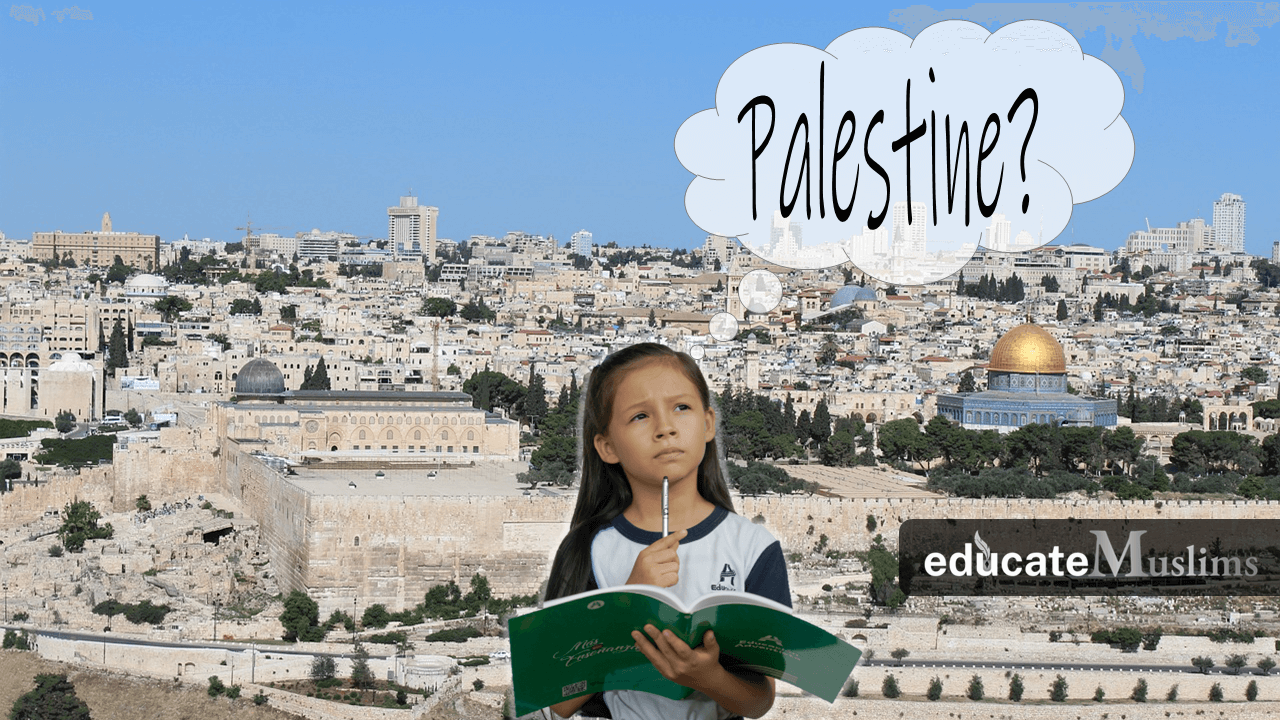
While some Muslim children may know the importance of Palestine for Muslims, many are unable to provide details and/or are unable to articulate the reasons clearly. Even more are unable to support those reasons with evidence (from religious texts, historical, and geographical sources, etc.). It is important for Muslim children to be able to understand and clearly articulate why Palestine is important for Muslims as it is one of the sources of contemporary global conflicts.
Introduction
In this question driven lesson (or unit plan), students play a game to explore the importance of Palestine for Muslims. Instead of direct instruction, teachers use well crafted close-ended questions paired with open-ended questions to guide thoughtful classroom discussions, reflect and make connections across topics, and gain deeper understandings. The lesson is intended to be introductory while providing for further inquiry and exploration. Educators can also use the Resources handout to develop a unit plan.
Grade Levels
3-12
Subject Areas
Civics, Current Events, Geography, Language, Religion, Social Studies, World History
Estimated Time
Two or more class periods
Learning Outcomes (Objectives)
By the end of this lesson, students will be able to:
- Articulate in their own words a response to the question, “Why is Palestine important to you?”
- List at least three points with evidence to illustrate why Palestine is important for Muslims.
- Analyze maps to understand world conflicts.
- Discuss how cultural appropriation and erasure can lead to cultural genocide and ethnic cleansing.
- Summarize and interpret the events of Isra & Miraaj.
- Trace the significance of Masjid Al-Aqsa.
- Explain the virtues of Masjid Al-Aqsa.
- Reframe the importance of Jerusalem to Judaism, Christianity, and Islam.
- Explain the opening of Jerusalem by Muslims.
- Illustrate the events leading to the Nakba and the continuing Palestinian-Israeli conflict.
Materials and Resources
- KWL Chart
- KWL Chart Rubric
- The game “What do I know about Palestine?” on Ahaslides.com (requires a free account to copy the game)
- Resources handout on “What do I know about Palestine?”
- Smart device per student/student group
- Projector or Smartboard to display the game
- Computer for teacher to present the game
- Internet connection
Activities
Activity 1: Focus Activity
- The KWL Chart: Ask students to individually respond to the questions on the KWL Chart on the topic of Palestine. Note: Do not pair students at this point. It is important for each student to think on their own at this point.
- Pair & Share: Pair up students and ask them to summarize the points they think are important from each student’s KWL chart.
- Class Discussion: Regroup as a class and ask each group to share their important points and questions. List the points on the board under each heading: 1. Know and 2. Wonder. Maintain a tally for each point that is also mentioned by other groups of students and rank them according to the tally.
Activity 2: Play the Game & Discuss
- Play the game “What do I know about Palestine?” on Ahaslides.com. Note: Students can play individually or in groups depending on the number of devices available for students.
- Provide feedback (background and details) on the answers before moving on to the next question using the Resources handout. Time permitting, have a class discussion using the open-ended questions for each of the closed-ended questions listed on the Cheat Sheet.
- Ask students to use the “My notes on Palestine” worksheet to take notes during the game. Note: Model for students how to take notes by summarizing the main points for at least the first two questions.
Activity 3: Putting it all together
- Ask students to complete the “Learned” column in the KWL Chart.
- Let students share with class what they have learned. You can also use the open-ended questions as prompts for further discussion.
- Ask students the following question: “Why is Palestine important to you?” Make a list of the points shared by students.
Assessment Suggestions
- Contributions in class discussions and group work
- KWL Chart: Use the KWL Chart Rubric to provide feedback to students
- Summative Assessment: Ask students to respond to the following prompts. Note: Adjust the expectations according to the grade level:
- Why is Palestine important to you?
- Why is Palestine important for Muslims?
Extensions and Adaptations
- Adjust the game according to the student’s level by removing/skipping questions.
- Develop a Unit Plan from each question in the game using the Resources Handout.
- Conduct a jigsaw learning activity using the annotated resources for each question.
- Ask students to use the annotated resources for each question to write a “position” paper.
Share via comments any feedback on the lesson, how to improve it, and share any related resources/strategies that can enhance the lesson so others can benefit.