Tag: Student Teacher Relationships

  • A New School Year Begins with the Right Intention

    A New School Year Begins with the Right Intention

    The beginning of a new school year is filled with preparation. Classrooms are organized, lessons are planned, resources are gathered, and procedures are reviewed. But for a Muslim teacher, there is another kind of preparation that matters just as much: preparing the heart and purpose behind the work.

    Before we ask, “What will I teach?”, we should ask, “Why am I teaching?”

    Before we establish classroom rules and routines, we should consider, “What kind of relationship do I want to build with my students?”

    And before the first lesson begins, we should remind ourselves that teaching is not simply a profession. When approached with the right intention, it can be an act of worship and a means of nurturing the next generation.

    Preparing for the First Days of School Through Tarbiyah

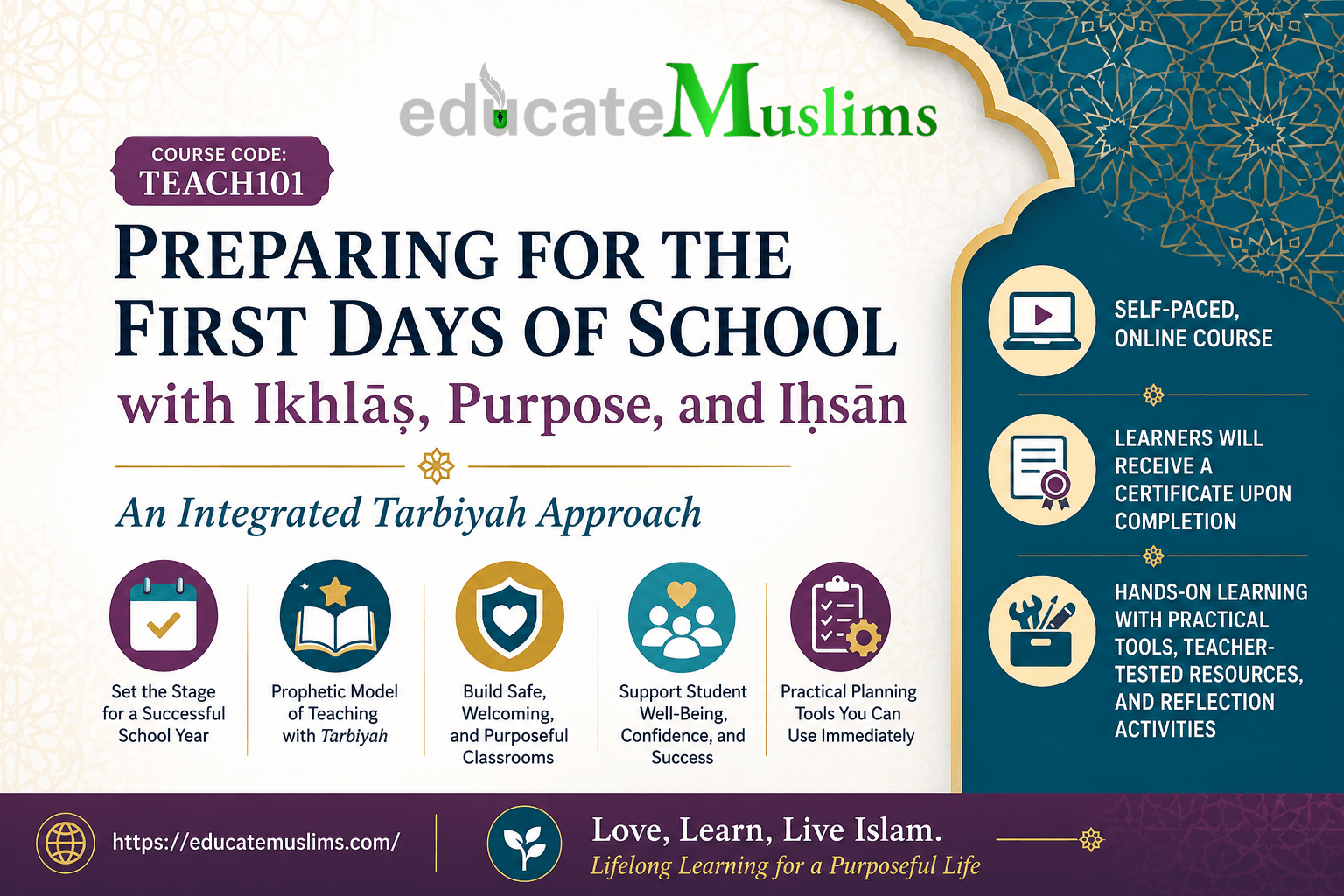
    This is the focus of TEACH101: Preparing for the First Days of School with Ikhlāṣ, Purpose, and Iḥsān: An Integrated Tarbiyah Approach to Teaching.

    The course brings together Islamic principles, the Prophetic model of tarbiyah, and insights from educational research to help Muslim educators approach the first days of school with greater intentionality.

    At the heart of the course are three qualities:

    Ikhlāṣ — Sincerity

    Renewing our intentions to teach sincerely for the sake of Allah and how we can make our teaching an act of ‘ibaadah (worship).

    Purpose — Direction

    Understanding that education is about more than academic achievement. It is also about nurturing students, developing character, and helping them grow toward their potential.

    Iḥsān — Excellence

    Striving to do our work with care, excellence, and awareness that Allah sees how we fulfill our responsibilities.

    The course explores practical questions that every teacher faces at the beginning of the year: How do we establish positive relationships with students? How do we create clear expectations and routines? How do we motivate students? How can our classroom environment reflect Islamic values?

    These are not merely classroom-management questions. They are tarbiyah questions.

    The first days of school can set the tone for everything that follows. They are an opportunity to communicate to students—not only through what we say, but through how we teach, listen, organize, correct, encourage, and care—that learning is meaningful and that every student has value.

    Start the School Year with Intention

    Whether you are a new teacher preparing for your first classroom or an experienced educator looking for a meaningful reset, TEACH101 offers an opportunity to pause, reflect, and prepare for the year ahead through an Islamic lens.

    Because effective teaching begins long before the first lesson.

    It begins with the heart.

    Explore TEACH101: Preparing for the First Days of School with Ikhlāṣ, Purpose, and Iḥsān: An Integrated Tarbiyah Approach to Teaching and prepare not only to teach—but to nurture, inspire, and serve with purpose.

    Explore the Course →

    Watch the introduction to the course:

  • Part 4 Lesson 3: Having a Hopeful Mindset for Ending the School Year on a Positive Note

    Part 4 Lesson 3: Having a Hopeful Mindset for Ending the School Year on a Positive Note

    A four parts series on Ending the School Year on a Positive Note: Part 1 | Part 2 | Part 3 | Part 4

    In this last of the 4 Parts series, Dr. Mohammed Saleem highlights the third and last lesson from Surah An Nasr that we can apply in our classrooms during the last days of school. The focus is on creating a hopeful mindset instead one of despair and classroom activities teachers can do to give hope to their students as we end the school year.

    Use the guiding key questions below for self-assessment and to plan for the last days of school.

    Watch the video to learn the answers to the following questions:

    • Why does Allah’s attribute of Al-Tawwab mean? How did it give hope to the Prophet (saw) as he was nearing the completion of his mission?
    • Why is it important to give hope to students as the school year comes to an end?
    • What classroom activities can we do to give hope to our students?

    Key Questions for End of Year

    Use these key questions for self-assessment and to make a plan for the last days of school.

    Relationships

    1. How well did I connect with Allah (swt) this year?
    2. How well did my students connect with Allah (swt) this year?
    3. How well did my students and I connect with each other?
    4. How well did my students connect with each other?
    5. How well did I connect with my colleagues? With the admin?
    6. Did I appreciate those who volunteered for me?
    7. Do I have a plan to recognize/appreciate/celebrate student achievements? (informal awards)
    8. What key messages do I need to share with my students?
    9. What key messages do I need to share with my parents? With colleagues?
    10. What is my plan to help each other forgive, forget, and move on? (Dua day)

    Reflections

    1. Did I survey the students for feedback? Favorite lessons, activities, least favorite, why?
    2. Did I survey the parents for feedback?
    3. Do I plan to revisit my lessons and classroom activities to determine what to use and modify for next year?
    4. Did I like my classroom management plan? What worked, what didn’t work so well?
    5. Did I accomplish everything I needed to?
    6. Did I teach the topics in a good order?
    7. How well did my lesson and activities align with the Tarbiyah framework?
    8. What were some of the frustrations in my life, in my classroom, or in my building that I may have to address to make next year more enjoyable?
    9. What was my favorite moment?
    10. What did I learn about teaching this year?
    11. Did I have a good work/personal life balance?
    12. Next year I would like to do more . Next year I would like to do less _.
    13. Next year I would like to try _.

    Learning

    1. Do I have a clear student assessment plan? Do I have enough sources of evidence for assessment?
    2. Did I communicate academic expectations with my students?
    3. Did I communicate with parents so they do not receive any unpleasant surprises?
    4. Did I have a plan for students missing assignments?
    5. Did I submit the final marks for all students?
    6. How am I going to formally recognize students for their achievements? (student awards, etc.)
    7. Am I going to ask students to create a Learning Transfer Map (LTM)? What knowledge and skills do I need to take with me for next year?

    Organizational

    1. Should I review student jobs to make sure they are aligned for the last days of school? (maybe focus more on clean up, organization, etc.)
    2. Did I re-organize my teacher resources and secure them so it is easier upon my return and/or to hand over? (think of sadaqah jaariyah)
    3. Did I take an inventory of all items (textbooks, supplies, etc.)?
    4. Did I return all the items that I checked out? (library, office keys, parking permits, etc.)
    5. Do I have a plan for students to clean their belongings and take them home?
    6. Did I secure the furniture, equipment, and other supplies?
    7. Did I clean up and re-organize my computer, emails, Google classroom (archive), any other e-resources I was using and get them ready for next year?
    8. Did I leave a vacation reply on my school email?

    Extending

    1. How can I extend my students’ learning during the summer to avoid the summer slump? (summer bucket list, summer learning package, etc.)
    2. Do I have a plan for my own self-development? Taking a course, reading a book, etc.?

    Next Year

    1. Did I finalize and submit a class supply list for next year?
    2. Did I communicate to the school admin what I need for next year?
    3. Did I complete and submit the EOY report?

    Last Days

    1. Do I have a set of activities for the last days of school? Gallery walks, check-ins, etc.
    2. How am I leveraging the school wide activities to keep students engaged?
    3. Do I have a plan for the last day of school?

    Don’t forget to share your own ideas on ending the school year on a positive note in the comments below.

  • Part 3 Lesson 2: Having a Mindset of Humbleness for Ending the School Year on a Positive Note

    Part 3 Lesson 2: Having a Mindset of Humbleness for Ending the School Year on a Positive Note

    A four parts series on Ending the School Year on a Positive Note: Part 1 | Part 2 | Part 3 | Part 4

    In this Part 3 of a 4 Parts series, Dr. Mohammed Saleem highlights the second lesson from Surah An-Nasr that we can apply in our classrooms during the last days of school. The focus is on creating a mindset of humbleness instead of boastfulness and arrogance as we celebrate the year’s successes and achievements.

    Watch the video to learn the answers to the following questions:

    • What was the second instruction from Allah (swt) to Prophet Muhammad (saw) to help him close off his mission on a positive note?
    • Why is it important to be humble during the last days of the school year?
    • What is one way we can show our humbleness to Allah (swt)?
    • What classroom activities can we do to teach humbleness?

    Don’t forget to share your own thoughts in the comments below.

  • Part 2 Lesson 1: Having a Mindset of Gratitude for Ending the School Year on a Positive Note

    Part 2 Lesson 1: Having a Mindset of Gratitude for Ending the School Year on a Positive Note

    A four parts series on Ending the School Year on a Positive Note: Part 1 | Part 2 | Part 3 | Part 4

    In this first lesson from Surah An Nasr, Dr. Mohammed Saleem highlights the importance of maintaining a mindset of gratitude during the last days of school and classroom activities teachers can do with their students to maintain that mindset.

    Watch the video to learn the answers to the following questions:

    • What is the first lesson we learn from Surah An-Nasr when it comes to closing of the school year?
    • What is the difference between tasbih and hamd? How do they relate to the last days of school?
    • What classroom activities can we do to show gratefulness?

    Don’t forget to share your own thoughts in the comments below.

  • Part 1-Introduction: Ending the School Year on a Positive Note

    Part 1-Introduction: Ending the School Year on a Positive Note

    A four parts series on Ending the School Year on a Positive Note: Part 1 | Part 2 | Part 3 | Part 4

    Indeed, deeds are based on their endings. -Prophet Muhammad (Bukhari 6607)

    Endings are very important! Prophet Muhammad (saw) is reported to have said, “Indeed, deeds are based on their endings.” In other words, our deeds are judged by Allah (swt) on how we end them. Watch these four parts series by Dr. Mohammed Saleem to learn from the life of Prophet Muhammad (saw) on how to end the school year on a positive note.

    Watch the video to learn the answers to the following questions:

    • How would the Prophet (saw) end the school year if he was teaching in one of the Islamic schools today? What would he (saw) do to make sure it ended on a positive note?
    • How was the Prophet’s (saw) relationship with his (saw) companions (ra), the students?
    • What level of teaching did the Prophet (saw) practice?
    • How did Allah (swt) guide Prophet Muhammad (saw) towards the end of his (saw) mission as a prophet?

    Don’t forget to share your own thoughts in the comments below.

  • Five tips for Muslim teachers to start the school year on a positive note

    Five tips for Muslim teachers to start the school year on a positive note

    The first second of the first minute of the first hour of the first day of school is the most important. First impressions are the most lasting. I created this video during the pandemic to remind teachers about the importance of starting off the school year on the right foot.

    The video focuses on the following 5 tips:

    • Tip 1: Renew our intentions.
    • Tip 2: Get to know each other as a person.
    • Tip 3: Plan out the first day.
    • Tip 4: Establish expectations early on.
    • Tip 5: Set the stage for success!

    Watch the video for more details on each tip. Scroll down to view resources to help you prepare for the first days of school.

    Five tips for Muslim teachers to start the school year on a positive note

    Subscribe to our Newsletter for updates on latest posts

    Resources to prepare for first days of school

    Here are some carefully curated resources mentioned in the video and some more to help you prepare for the first days of school.

    Do you have any tips to help teachers start off the school year on a positive note? Please take a moment to post them in the comments below!

  • Tips to maximize our reward (ajar) during the last days of school

    Tips to maximize our reward (ajar) during the last days of school

    Dear Teacher,

    It has been a long year of planning, teaching, redirecting, and grading. Summer is tantalizingly close yet seems so far away! You are tired, stressed, and ready to “coast” or even thinking about throwing in the towel! But wait, not yet! The last days of school are absolutely crucial in ensuring that our hard work bears the most fruit.

    I will focus on two main reasons why we need to pay attention to what we do as the school year comes to a close:

    1. Deeds are judged by how they end

    One may run an amazing race but most races are judged by how they end. We may have enjoyed the different plays during a game but the ending usually colors our final perception of the game. Our beloved Prophet Muhamamd ﷺ would remind his companions about the importance of the endings of deeds by saying,

    …وَإِنَّمَا الأَعْمَالُ بِخَوَاتِيمِهَا
    “…and verily, the (results of) deeds done, depend upon the last actions.”1

    This saying is part of a much larger hadith where the Prophet ﷺ declared a man to be from the dwellers of hell even though he was fighting bravely on the battlefield because he ended up committing suicide upon being injured.

    Allah ﷻ too judges deeds according to their endings. Therefore, it is extremely important that we pay attention to how we end the school year if we want to preserve our reward with Allah ﷻ.

    2. Last impressions are most remembered

    Much like a sour bite at the end of a sweet dessert can skew our opinion about the dessert, students will judge the year by how it ends. This is known as the peak-end rule, a heuristic where we judge an experience based on how we feel at its peak and/or at its end rather than on the totality of the experience.

    Kahneman and his colleagues provided evidence to the peak-end rule in a study where participants were subjected to two different versions of an unpleasant experience.2 In the first trial participants were asked to submerge their hands in 14 degrees celsius water for 60 seconds and in the second trial they were asked to submerge the other hand in 14 degrees celsius water for 60 seconds and for an additional 30 seconds during which the water temperature was raised to 15 degrees celsius. Subjects were more willing to repeat the second trial when asked which trial they wanted to repeat. From this and other similar studies, Kahneman et al. concluded that subjects opted for the second trial simply because they liked the memory of it better or disliked it less than the alternative.

    Emotionally charged last impressions

    Another aspect of the peak-end rule posits that people better remember more intensely emotional events than less intensely emotional events. An emotional and good ending to a school year will influence students to reconsider even their negative experiences during the year in a positive light or at least dismiss them as irrelevant. If we want students to cherish, remember and perhaps even practice what we taught them it is imperative that we leave them with an emotionally charged good impression of the school year.

    So here are some tips to maximize our ajar during the last days of school:

    Tip 1: Renew our intentions

    Remind ourselves why we are here. Why are we working in an Islamic school? What is the purpose? Is it to please Allah ﷻ and an expression of our devotion to Him OR is it a career choice? Do we hope that through this Allah ﷻ will have mercy on us and will bless us with jannah OR are we seeking the praise of people or some other worldly gain? We are here because we want to serve Allah ﷻ by serving others OR is it to help ourselves?

    Most of us know the famous hadith on intentions where the Prophet ﷺ is reported to have said:

    إنَّمَا الْأَعْمَالُ بِالنِّيَّاتِ، وَإِنَّمَا لِكُلِّ امْرِئٍ مَا نَوَى، فَمَنْ كَانَتْ هِجْرَتُهُ إلَى اللَّهِ وَرَسُولِهِ فَهِجْرَتُهُ إلَى اللَّهِ وَرَسُولِهِ، وَمَنْ كَانَتْ هِجْرَتُهُ لِدُنْيَا يُصِيبُهَا أَوْ امْرَأَةٍ يَنْكِحُهَا فَهِجْرَتُهُ إلَى مَا هَاجَرَ إلَيْهِ

    Actions are according to intentions, and everyone will get what was intended. Whoever migrates with an intention for Allah and His messenger, the migration will be for the sake of Allah and his Messenger. And whoever migrates for worldly gain or to marry a woman, then his migration will be for the sake of whatever he migrated for.3

    Sincere intentions are like a catalyst that can render the most insignificant deeds into sources of great ajar and without them even the most admirable deeds can be rendered worthless. The reward for deeds done with pure intentions is limitless.

    Pure intentions bring peace of mind

    Pure intentions make us steadfast and bring us peace of mind. This is especially the case when the going becomes difficult, as it usually does during the end of a school year. The reward for our efforts is preserved with Allah ﷻ no matter the outcome if our intention is sincerely for the sake of Allah and we have put in the proper effort. This understanding helps us to remain steadfast and not to become devastated by unexpected results.

    Maintaining sincere intentions requires continuous effort. One may start with pure intentions but then a variety of factors may pollute our intentions. That’s why it was the habit of the pious to renew their intentions before, during, and after doing something. One of the duas of the Prophet ﷺ that can help us maintain the sincerity of our intentions is:

    اللهم مصرف القلوب صرف قلوبنا على طاعتك

    O Allah! Controller of the hearts, direct our hearts to Your obedience.4

    Tip 2: Be humble and seek Allah’s forgiveness

    As Prophet Muhammad’s ﷺ mission was coming to an end, Allah ﷻ revealed to him ﷺ Surah An-Nasr in which He ﷻ says:

    بِسۡمِ ٱللَّهِ ٱلرَّحۡمَـٰنِ ٱلرَّحِيمِ
    إِذَا جَآءَ نَصۡرُ ٱللَّهِ وَٱلۡفَتۡحُ (١) وَرَأَيۡتَ ٱلنَّاسَ يَدۡخُلُونَ فِى دِينِ ٱللَّهِ أَفۡوَاجً۬ا (٢) فَسَبِّحۡ بِحَمۡدِ رَبِّكَ وَٱسۡتَغۡفِرۡهُ‌ۚ إِنَّهُ ۥ ڪَانَ تَوَّابَۢا (٣)

    In the name of Allah, the Gracious, the Merciful. 1. When there comes Allah’s victory, and conquest. 2. And you see the people entering Allah’s religion in multitudes. 3. Then celebrate the praise of your Lord, and seek His forgiveness. He is the Acceptor of Repentance.5

    In fact Abdullah ibn Abbas (ra) states that this is the last complete Surah of the Quran to be revealed to the Prophet ﷺ.6 In it Allah ﷻ enjoined His beloved ﷺ to busy himself in praising and glorifying Allah ﷻ by Whose bounties and help he had been able to achieve such a great victory and that he ﷺ should beseech Allah’s forgiveness in whatever failings and weaknesses he may have shown in the performance of his mission. None of us can match the Prophet ﷺ in terms of his sincerity, commitment, and hard work and who was protected from Shaytan by Allah ﷻ. What about us?

    Be humble

    People tend to boast and brag about their successes attributing them to their own excellence. By praising Allah, we remind ourselves that all success is solely due to Allah’s favor and mercy. Allah has many soldiers and He could have blessed others with this work but He ﷻ chose us. Accordingly, we must humble ourselves and increase Allah’s praise as the school year comes to a close. We should remind ourselves and each other of this and the school halls and rooms should reverberate with the praise of Allah ﷻ during the last days of school.

    Seek Allah’s forgiveness

    The thought may also come at the end of a successful school year that we have fulfilled Allah’s rights on us with our “superb” efforts and abilities and this is enough for us to get into jannah. This is how shaytan traps those he is unable to dissuade from doing good. We can never fulfill Allah’s rights over us even if we were to live a thousand lifetimes of perfect servitude to Him ﷻ! Therefore, the mindset of a believer is that of seeking Allah’s forgiveness while reflecting on one’s own weaknesses and missed opportunities where we could have done better.

    It is this etiquette of humility and seeking forgiveness that we must inculcate in ourselves and our students. An expression of this is to remain open to feedback from others. End of year student and parent surveys can provide insights into our efforts that can be humbling while at the same time help us identify areas of growth. This is also an opportunity for us to train students in the art of providing constructive feedback in a mutually respectful manner, an important skill to have in the consumer driven societies we live in.

    Many frustrations come to the surface as the end of the school year approaches and complaints come more easily to our tongues. It is important to remember that a complaint, unlike constructive feedback, comes from a place of ungratefulness where the blessings we enjoy are not taken into consideration. As such, complaints are not only effective in realizing the change we are seeking but can also diminish our reward with Allah ﷻ. Use this End of Year Report template to make sure your concerns are communicated in a constructive manner.

    Tip 3: End on positive relationships

    Positive relationships for teachers are important for two main reasons: 1. Positive student-teacher relationships have been identified with high academic success and as a means through which students feel more confident and engaged in academics.7 2. The reward for our deeds is directly tied to how we treat others.

    “Do you know who is a muflis?”

    Once the Prophet ﷺ asked his companions, “Do you know who is a muflis (bankrupt)?”8 The companions responded that a muflis is someone who doesn’t have neither dirham (money) nor wealth. Then the Prophet ﷺ corrected them by saying that a muflis from my ummah is someone who would come on the Day of Resurrection with prayers, fasts, and zakah but would find himself without any reward since he had insulted someone, falsely accused so and so, eaten someone’s wealth, spilt someone’s blood, and struck someone. His virtues will be credited to those who suffered at his hands. And if his good deeds fall short of clearing what he owes to others then their sins would be entered into his account until he is thrown into the Fire.

    We intuitively know the power of relationships and work very hard throughout the year to build positive relationships with our students, parents, and other stakeholders. But tensions and conflicts are inevitable and unavoidable. Sometimes we may unknowingly hurt others in our zeal to get the point across or redirect one of our students in a manner that hurts them. It is important that we make amends with those whom we may have hurt knowingly or unknowingly not only to ensure an optimal academic learning environment but also to secure the reward from Allah ﷻ.

    Making amends

    End of year celebrations are an excellent opportunity to make amends. A gift, a card, a hug, or a kind word given at the right moment can heal and mend relationships like no other. Teachers can set up opportunities in the form of end of year class parties where students have the opportunity to say a kind word or exchange kind notes. Award ceremonies and graduations are excellent opportunities for teachers to recognize and acknowledge something positive about their students. Principals and school leaders should also organize staff appreciation events where staff have the opportunity to do the same. One thing that has always worked well for me is to have staff anonymously submit something positive about a colleague of theirs that made a positive impact on them. I would then share those messages at an end of year staff meeting as a way to recognize them. You can always share your own words of kindness for those staff that may not have received any positive feedback from their colleagues and since all comments were submitted anonymously, no one is the wiser!

    Tip 4: Tie up any loose ends

    Do your best to tie up any loose ends and leave things organized as much as possible not only to ensure a smoother start in Fall but also because Allah has prescribed ihsan (excellence) in everything that we do.9 This End of year checklists can help us to make sure that we minimize any loose ends.

    There are many more ways to maximize and preserve our reward as the school year comes to an end. If you have any related tips then please do share in the comments!

    I ask Allah ﷻ to help all of us to end the school year successfully, on a positive note, to accept our efforts and to reward us immeasurably. I end with this beautiful dua of Abu Bakr as-Siddiq (ra):

    اللَّهُمَّ اجْعَلْ خَيْرَ زَمَانِيْ آخِرَهُ، وَخَيْرَ عَمَلِيْ خَوَاتِمَهُ، وَخَيْرَ أَيَّامِيْ يِوْمَ أَلقَاكَ

    O Allah, let the best of my lifetime be its ending, and my best deed be that which I seal [my life with], and the best of my days the day I meet You.10


    References