A four parts series on Ending the School Year on a Positive Note: Part 1 | Part 2 | Part 3 | Part 4
In this Part 3 of a 4 Parts series, Dr. Mohammed Saleem highlights the second lesson from Surah An-Nasr that we can apply in our classrooms during the last days of school. The focus is on creating a mindset of humbleness instead of boastfulness and arrogance as we celebrate the year’s successes and achievements.
Watch the video to learn the answers to the following questions:
What was the second instruction from Allah (swt) to Prophet Muhammad (saw) to help him close off his mission on a positive note?
Why is it important to be humble during the last days of the school year?
What is one way we can show our humbleness to Allah (swt)?
What classroom activities can we do to teach humbleness?
Don’t forget to share your own thoughts in the comments below.
A four parts series on Ending the School Year on a Positive Note: Part 1 | Part 2 | Part 3 | Part 4
In this first lesson from Surah An Nasr, Dr. Mohammed Saleem highlights the importance of maintaining a mindset of gratitude during the last days of school and classroom activities teachers can do with their students to maintain that mindset.
Watch the video to learn the answers to the following questions:
What is the first lesson we learn from Surah An-Nasr when it comes to closing of the school year?
What is the difference between tasbih and hamd? How do they relate to the last days of school?
What classroom activities can we do to show gratefulness?
Don’t forget to share your own thoughts in the comments below.
A four parts series on Ending the School Year on a Positive Note: Part 1 | Part 2 | Part 3 | Part 4
Indeed, deeds are based on their endings. -Prophet Muhammad (Bukhari 6607)
Endings are very important! Prophet Muhammad (saw) is reported to have said, “Indeed, deeds are based on their endings.” In other words, our deeds are judged by Allah (swt) on how we end them. Watch these four parts series by Dr. Mohammed Saleem to learn from the life of Prophet Muhammad (saw) on how to end the school year on a positive note.
Watch the video to learn the answers to the following questions:
How would the Prophet (saw) end the school year if he was teaching in one of the Islamic schools today? What would he (saw) do to make sure it ended on a positive note?
How was the Prophet’s (saw) relationship with his (saw) companions (ra), the students?
What level of teaching did the Prophet (saw) practice?
How did Allah (swt) guide Prophet Muhammad (saw) towards the end of his (saw) mission as a prophet?
Don’t forget to share your own thoughts in the comments below.
According to the World Health Organization, anxiety and depression increased by 25% globally during the first year of the COVID-19 pandemic. 1 Mental health became a global crisis and health agencies around the world included this as a major component in their response to the pandemic. The pandemic exposed previously existing gaps in the mental health services, within families, and in our personal selves. We continue to grapple with worsened mental health and well-being.
Finding ways to deal with anxiety and stress
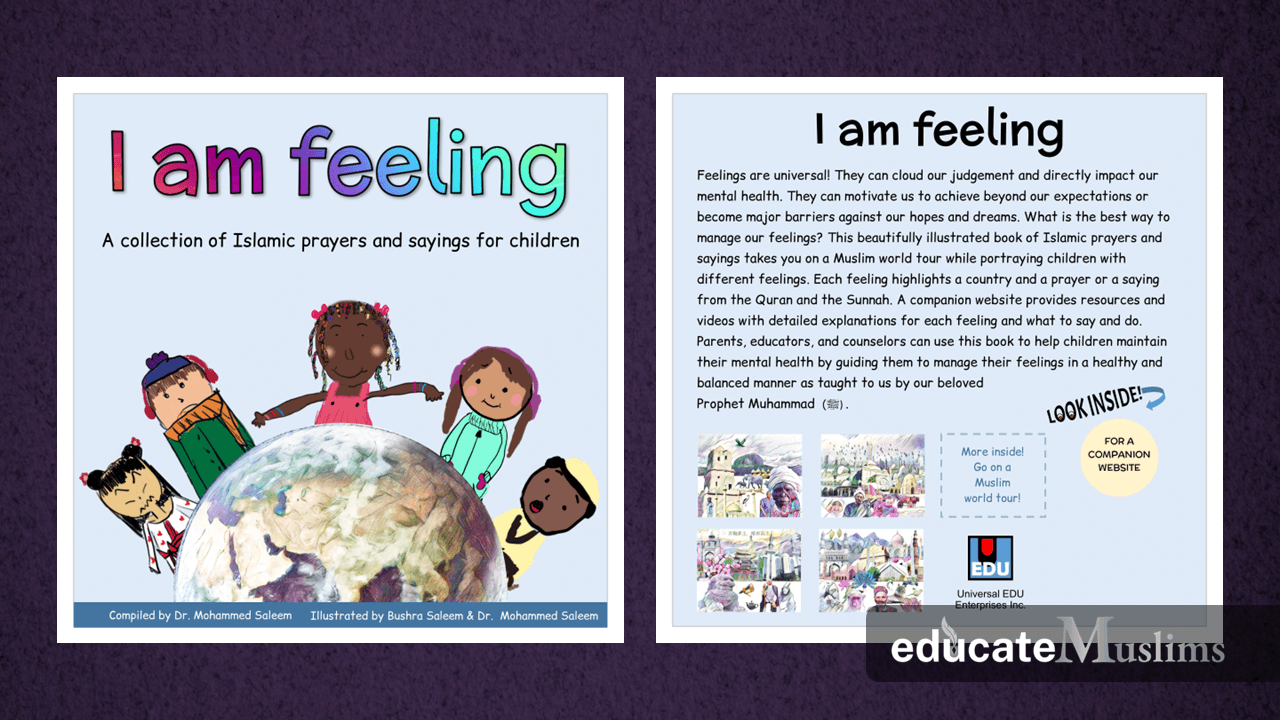
During the pandemic, many of us found ways to deal with fear, loneliness, suffering, death, grief, and financial stress. Many turned to Allah ﷻ for solace. Some of us took on new hobbies such as gardening or cooking while others increased our exercise regimen. Some among us started small businesses and others started blogs or wrote books. For many of us, it was a combination of several things that kept us occupied and helped us manage our anxieties. My daughter and I are among the latter. Along with doing many other things, we published an illustrated children’s book on feelings with some unique twist, titled “I am feeling: A collection of Islamic prayers and sayings for children”.2
Dealing with isolation
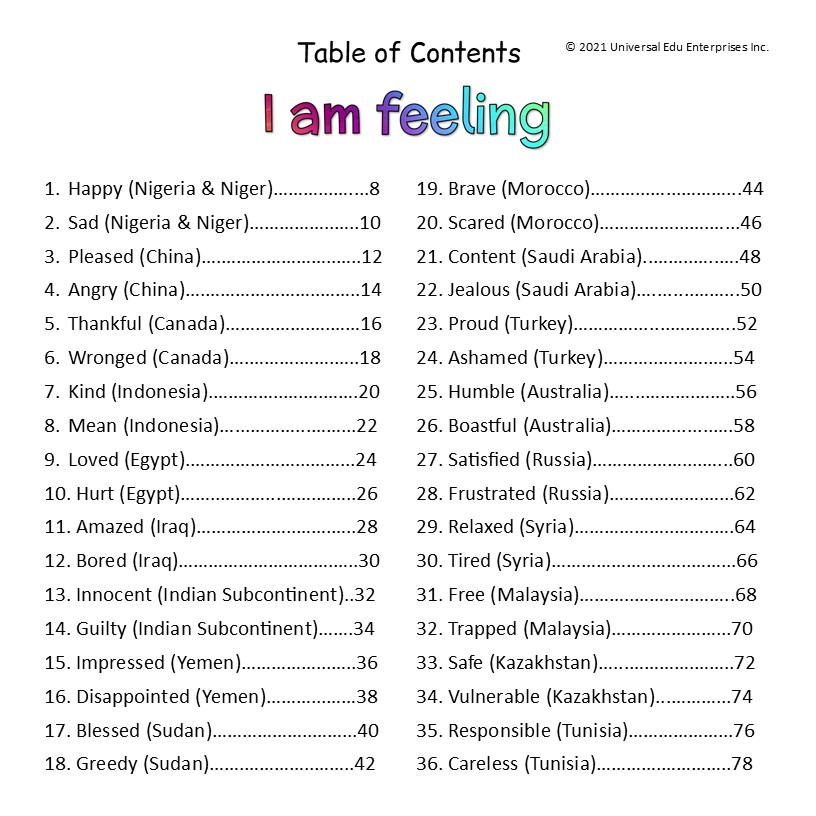
During the pandemic, when travel was off the table (not that we traveled much before), we found a creative way to explore the world from our kitchen. Each week, we cooked dishes from different Muslim-majority countries, bringing their flavors to our table. We savored biryani from India, couscous from Morocco, kabsa from Saudi Arabia, bibimbap from Korea, and many more! As we cooked, we also delved into the history of Muslims in each country, discovering how they expressed their faith through unique cultural traditions. This journey not only enriched our culinary knowledge but also inspired us to pair each dish with a set of opposing emotions (see below the Table of Contents from the book), helping us to highlight the universal nature of human feelings.
Table of Contents from the book, “I am feeling: A collection of Islamic prayers and saying for children
Feelings are universal!
Regardless of where we come from, how we look, male or female, rich or poor, we all feel! Feelings are universal, yet we express them in a variety of ways depending on our culture. We express our feelings through emotions and our emotions are shaped by the culture we grow up and live in.3 For example, Americans generally laugh out openly and wholeheartedly to a joke but Germans display a more reserved response to amusement. Grieving the deceased in European Catholic cultures is endured stoically; whereas, in many African cultures, is expressed loudly and is viewed as a sign of respect for the deceased.
Feelings in the digital world
As we unpacked each feeling in terms of how it was expressed in different cultures, we also saw many similarities. The common use of emoticons and emojis to easily communicate one’s feelings with someone on the other side of the planet was immediately noticeable. Internet technologies have blurred traditional boundaries and have enabled us to connect with others across cultures at a deeper level through our feelings and emotions with great ease while minimizing cross cultural misunderstandings.45
The role of Islam in helping us express our feelings
We also recognized the great similarity in how Muslims from across the world expressed their feelings and emotions. The use of alhamdulillah (ٱلْحَمْدُ لِلَّٰهِ) for gratitude, subhanallah (سُبْحَانَ ٱللَّٰهِ) for wonderment, astaghfirullah (أَسْتَغْفِرُ اللّٰهَ) for discontent, insha’allah (إِنْ شَاءَ ٱللَّٰهُ) for hopefulness, mashaallah (مَا شَاءَ ٱللَّٰهُ) for acknowledgement and many other Islamic sayings were commonly and universally practised across cultural boundaries; a testament to how Islam united people across cultures. Islam has played an important role in tempering how we express our feelings in a balanced manner and use them to connect deeply with Allah ﷻ.
Emotional intelligence in the Qur’an
Islam has put great emphasis on the development of emotional intelligence. Unlike contemporary secular education, learning in Islam emphasizes the development of the qalb (heart) over cognitive development. As such, the Qur’an is replete with stories and emotionally charged content and as we read the Qur’an we are expected to experience and express a variety of feelings and emotions. Allah ﷻ says in the Qur’an:
And when they hear what was revealed to the Messenger, you see their eyes overflowing with tears, as they recognize the truth in it. They say, “Our Lord, we have believed, so count us among the witnesses.” (Quran, 5:83).6
Allah has sent down the best of narrations: A Scripture consistent and paired. The skins of those who reverence their Lord shiver from it, then their skins and their hearts soften up to the remembrance of Allah. Such is Allah’s guidance; He guides with it whomever He wills. But whomever Allah leaves astray, for him there is no guide. (Quran, 39:23).
WWMD? How did Prophet Muhammad ﷺ express his feelings and emotions?
Prophet Muhammad ﷺ was the quintessential embodiment of how we should manage and express our feelings. Through him ﷺ we learn the value of gentleness over harshness, kindness over meanness, forgiveness over revenge, and love and compassion over hatred and cruelty. He showed us how to cry, smile, and laugh without going to extremes where we may lose ourselves. Some of his best expressions of feelings and emotions can be found in the many du’as (prayers) that he ﷺ taught us.
The importance of developing emotional literacy in children
My family and I started learning how to manage our own feelings and emotions as we attempted to align the many du’as of our beloved Prophet ﷺ to a variety of feelings and emotions. We learned that the du’as increased our emotional literacy as they enabled us to reflect on our own feelings and empathize by recognizing them in others. They developed our emotional intelligence by providing a scaffold to understand and manage our emotions. By reciting the du’as together, we were also able to influence each other’s feelings.
Children often learn how to express their feelings and emotions implicitly through their social interactions. Such an inconsistent and passive approach may not lead to desired results. It is important to proactively train children to manage their feelings and emotions and to develop empathy from a very young age. Emotional literacy must form an important component of children’s education at both the home and the school.
InshaAllah, in this SEL series, we will explore contrasting feelings within an Islamic context while meeting Muslim characters from across the world. In the process, we will learn du’as to manage our feelings. Though not needed, we encourage you to purchase a hard copy of our illustrated children’s book as it can be quite helpful to scaffold related discussions and conversations with children: https://www.amazon.ca/dp/1777522102
Cookie Consent
We use cookies to improve your experience on our site. By using our site, you consent to cookies.
Contains information related to marketing campaigns of the user. These are shared with Google AdWords / Google Ads when the Google Ads and Google Analytics accounts are linked together.
90 days
__utma
ID used to identify users and sessions
2 years after last activity
__utmt
Used to monitor number of Google Analytics server requests
10 minutes
__utmb
Used to distinguish new sessions and visits. This cookie is set when the GA.js javascript library is loaded and there is no existing __utmb cookie. The cookie is updated every time data is sent to the Google Analytics server.
30 minutes after last activity
__utmc
Used only with old Urchin versions of Google Analytics and not with GA.js. Was used to distinguish between new sessions and visits at the end of a session.
End of session (browser)
__utmz
Contains information about the traffic source or campaign that directed user to the website. The cookie is set when the GA.js javascript is loaded and updated when data is sent to the Google Anaytics server
6 months after last activity
__utmv
Contains custom information set by the web developer via the _setCustomVar method in Google Analytics. This cookie is updated every time new data is sent to the Google Analytics server.
2 years after last activity
__utmx
Used to determine whether a user is included in an A / B or Multivariate test.
18 months
_ga
ID used to identify users
2 years
_gali
Used by Google Analytics to determine which links on a page are being clicked
30 seconds
_ga_
ID used to identify users
2 years
_gid
ID used to identify users for 24 hours after last activity
24 hours
_gat
Used to monitor number of Google Analytics server requests when using Google Tag Manager