In Episode 3 of TAWHIDtalk, we explore our relationship with Al-ʿAlīm—the All-Knowing and how that relationship should shape the way we learn, teach, and seek knowledge. Recognizing Allah as the ultimate source of knowledge reminds us of our dependence upon Him and transforms the pursuit of knowledge into an act of worship and a means of drawing closer to Allah.
Key Timestamps & Topics
[00:00] Introduction
From Allah as the source of knowledge to our relationship with Him as we pursue knowledge.
[02:28] Allah’s Complete Knowledge
Allah’s perfect knowledge compared with the limits of human knowledge.
[03:51] Seeking Knowledge as ʿIbādah
How seeking knowledge becomes an act of worship.
[04:50] Preparing for the “Weighty Revelation”
Why the Prophet (saw) and the early Muslims were commanded to stand in prayer at night.
[05:51] “Read in the Name of Your Lord”
How worship, knowledge, and closeness to Allah are connected and implications for educators.
Core Takeaways & Themes
What should our relationship with Allah look like as we pursue knowledge?
In the previous episode of TAWHIDtalk, we explored the foundational question: What is the source of all knowledge? We established that Allah (swt) is Al-ʿAlīm—the All-Knowing—and that all knowledge ultimately comes from Him.
But recognizing Allah as the ultimate source of knowledge leads to another, deeper question:
How should our relationship with Allah shape the way we seek, acquire, teach, and use knowledge?
In Episode 3, TAWHIDtalk explores our relationship with Al-ʿAlīm—the All-Knowing and what that relationship means for anyone involved in education.
Allah’s knowledge is complete. Ours is limited. We discover. We learn. We investigate. We teach. Yet the ability to know—and the knowledge itself—is ultimately a gift from Allah (swt).
The closer we are to Allah, the more we recognize our dependence upon Him as the source of all knowledge. Seeking knowledge therefore becomes more than an intellectual activity. It can become an act of ʿibādah (worship) through which we strengthen our relationship with Allah.
The Qur’an provides a powerful example in the early mission of the Prophet Muhammad (saw). Allah commanded the Prophet (saw) in Surah Al-Muzzammil to stand in prayer during the night. The Prophet (saw) and the early Muslims were being prepared spiritually for the enormous responsibility of receiving, carrying, teaching, and living by Allah’s revelation and to fulfill the first command given to them.
The first revealed verses began with the command:
ٱقْرَأْ بِٱسْمِ رَبِّكَ ٱلَّذِى خَلَقَ
Read in the Name of your Lord Who created. (Qur’an 96:1)
And the final verse of the same surah, Surah Al-ʿAlaq, reminds the Prophet (saw):
كَلَّا لَا تُطِعْهُ وَٱسْجُدْ وَٱقْتَرِب ۩ ١٩
Again, no! Never obey him ˹O Prophet˺! Rather, ˹continue to˺ prostrate and draw near ˹to Allah˺. (Qur’an 96:19).
Once again, reminding the Prophet (saw) to draw closer to Allah (swt), strengthen his relationship with Allah (swt) by engaging in prostrations, which refers to salah.
Together, these verses point toward a profound principle: the pursuit of knowledge is closely linked to our relationship with Allah (swt).
For teachers, school administrators, students, parents, and anyone on the path of learning, the message is clear: strengthen your relationship with the ultimate source of knowledge—Allah (swt), the Teacher of all humanity.
References and Resources
Surah Al-Anʿām 6:59 — Allah’s complete knowledge of the unseen and everything in creation.
Surah Al-Muzzammil 73:1–5 — The command to the Prophet (saw) to stand in prayer and prepare for the “weighty” revelation.
Surah Al-ʿAlaq 96:1–5 — The first revelation: “Read in the Name of your Lord,” and Allah’s teaching of humanity.
In Episode 2 of TAWHIDtalk, we explore a foundational question: What is the source of all knowledge? From an Islamic worldview, all knowledge ultimately comes from Allah (swt), Al-ʿAlīm—the All-Knowing. While we acquire knowledge through our senses, reason, observation, research, and experience, our ability to know is itself a gift from Allah. What does this understanding mean for the way we teach, learn, and pursue knowledge? This episode lays the foundation for exploring how tawḥīd shapes our approach to education and learning.
Key Timestamps & Topics
[00:00] Introduction
[02:01] What is the source of knowledge?
[02:47] Thinking there are other sources of knowledge can constitute shirk.
[03:02] Names and attributes of Allah related to knowledge.
[05:31] Allah is the first teacher of humanity.
[06:28] Knowing Allah through His divine attributes that relate to knowledge is crucial for every merchant of knowledge.
Core Takeaways & Themes
Allah is the ultimate source of all knowledge
Islam begins with a fundamentally different understanding of knowledge: Allah (swt) is Al-ʿAlīm, the All-Knowing. Human beings may acquire knowledge through their senses, reason, research, observation, and experience, but our capacity to know ultimately comes from Allah.
Allah’s Knowledge Is Perfect and Comprehensive
The Qur’an describes Allah as the Knower of the unseen and emphasizes that nothing is hidden from Him. His knowledge encompasses what is apparent and hidden, what is known and unknown to creation. Allah as ʿAllām al-Ghuyūb, the Knower of the unseen (Qur’an 5:109). Allah knows our secrets and private conversations (Qur’an 9:78).
Humanity’s Journey With Knowledge Begins With Allah
The Qur’an tells us that Allah taught Adam (as) “the names of all things” (Qur’an 2:31). This provides an important foundation for an Islamic understanding of knowledge: human beings are not independent sources of knowledge, but recipients of knowledge and abilities that Allah has gifted them.
Teaching and Learning Are Connected to Our Relationship With Allah
Whether we are teachers, students, researchers, parents, or lifelong learners, we should not lose sight of the One who gave us the capacity to know. Learning can therefore become more than the accumulation of information; it can become part of our relationship with Allah.
The next episode continues this exploration by asking: If Allah is Al-ʿAlīm—the All-Knowing—what should our relationship with Him look like, and how should that relationship shape the way we learn and teach?
Divine Names Related to Knowledge
The episode reflects on several of the Asmāʾ al-Ḥusnā (Beautiful Names of Allah) connected to Allah’s knowledge and awareness:
Al-ʿAlīm (الْعَلِيم) — The All-Knowing
ʿAllām al-Ghuyūb (عَلَّام الْغُيُوب) — The Knower of the Unseen
Al-Khabīr (الْخَبِير) — The All-Aware / Fully Acquainted
Al-Laṭīf (اللَّطِيف) — The Subtle / Subtle-Perceiver
Al-Ḥakīm (الْحَكِيم) — The All-Wise
Ash-Shahīd (الشَّهِيد) — The All-Witnessing
Al-Baṣīr (الْبَصِير) — The All-Seeing
As-Samīʿ (السَّمِيع) — The All-Hearing
Al-Muḥṣī (الْمُحْصِي) — The All-Enumerating / Reckoner
Al-Bāṭin (الْبَاطِن) — The Hidden
Ar-Raqīb (الرَّقِيب) — The All-Watchful
References and Resources
Qur’an 2:31 — Allah teaches Adam (as) “the names of all things,” providing a foundational Qur’anic reference for humanity’s relationship with knowledge.
Qur’an 5:109 — Allah is described as ʿAllām al-Ghuyūb, the Knower of the unseen.
Qur’an 9:78 — Allah knows what is secret and what is privately spoken, and He is described as the Knower of the unseen.
Qur’an 2:282 — “And Allah teaches you. And Allah is Knowing of all things.” This verse reinforces the connection between Allah, teaching, and knowledge.
A school calendar is not a neutral tool. We usually inherit the structure from the dominant educational system and simply adapt it to our needs. In doing so, we unintentionally bring into our schools a value system of the dominant culture that may not necessarily be aligned with Islamic values.
Many attempts to “Islamize” schooling focus on adding Islamic symbols, terminology, or occasional celebrations. While these efforts have value, they often leave the deeper structures of schooling untouched.
The calendar is one of those deeper structures.
A school calendar communicates what a community values. It shapes how students experience time, anticipate important events, and organize their lives.
Integrating the Hijri calendar invites students to experience time through an Islamic lens. It creates opportunities to discuss sacred months, significant historical events, the lunar cycle, moon sighting, and the connection between worship and time. It reminds students that Islam is not confined to a subject period in the timetable but provides a framework for organizing life itself. This reflects the broader educational goal of nurturing a coherent Islamic identity rather than treating faith as an isolated component of schooling.
As educators in Islamic schools, it is important for us to pay careful attention to developing the school calendar. We must critically assess the constraints of operating within an educational system that may not align with the Islamic worldview and identify those elements in the school calendar that can be negotiated to be replaced with the Hijri calendar.
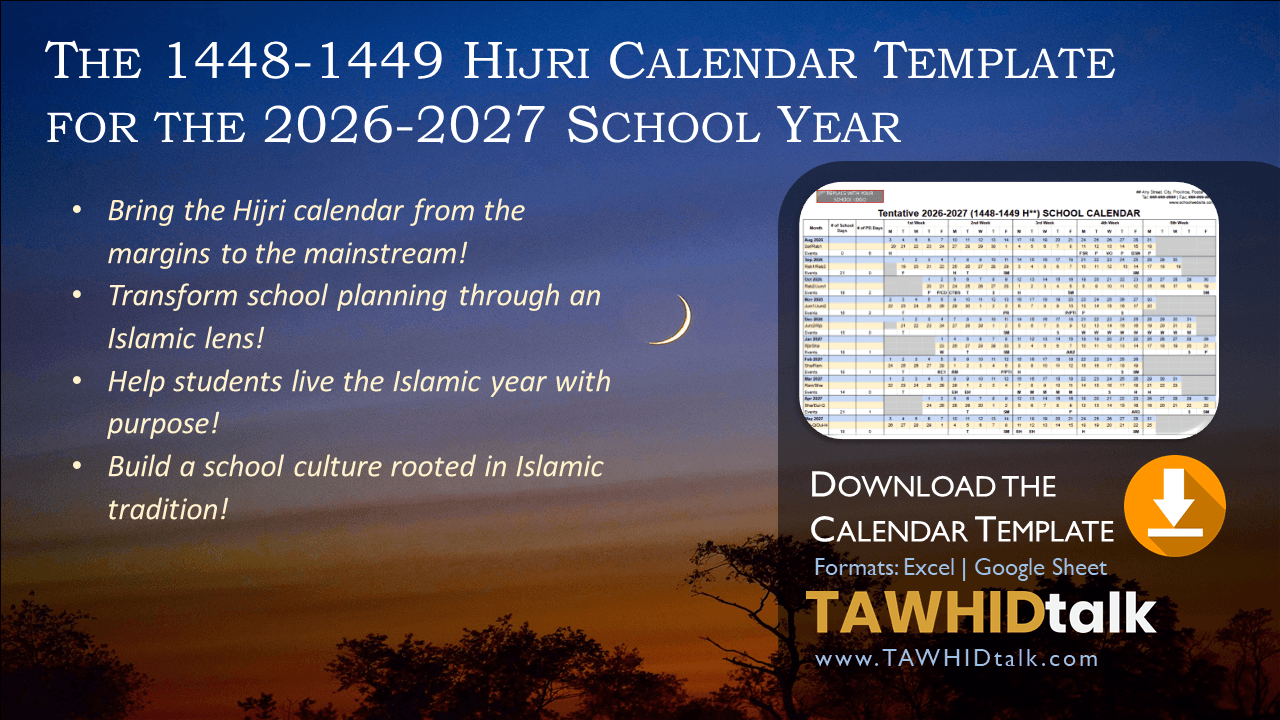
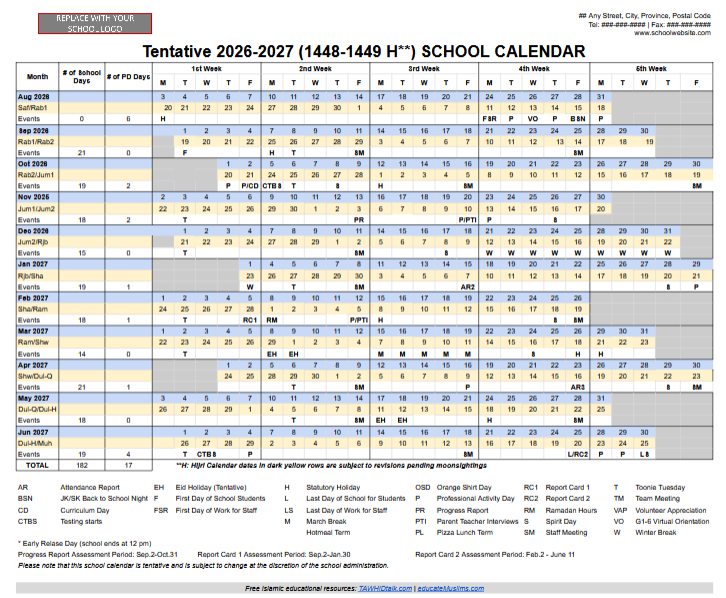
For this reason, I am pleased to share the 1448–1449 Hijri Calendar Template for the 2026–2027 School Year.
Customize by Copying the google Sheet to Your drive
1448-1449 Hijri School Calendar for the 2026-2027 School Year
This template is more than a scheduling tool. It is a practical resource that helps Islamic schools integrate the Hijri calendar into the daily life of the school and reconnect learning with an Islamic worldview.
To better understand the ideas behind this calendar template, I encourage readers to explore the following articles. The first introduces the rationale for integrating the Hijri calendar into the life of an Islamic school, while the second examines how the calendar itself reflects and reinforces a particular worldview. Together, they provide the educational and philosophical foundation for the 1448–1449 Hijri School Calendar Template.
In this inaugural episode, we explore Tawhid beyond a strictly theoretical or theological construct, framing it as an active, unifying worldview. We examine how centering Tawhid shapes personal ethics, community dynamics, modern education, and spiritual practice in everyday contemporary life.
Key Timestamps & Topics
[00:00] Introduction
[00:47] What does Islam say about the world we areliving in?
[01:19] Beyond Rituals: Why Tawḥīd is a complete framework for life, not just abstract theology.
[01:49] I am your host Mohammed Saleem.
[02:31] Today we live in a world with competing ideas about what it means to be human.
[03:01] What happens when we examine ideas through the lens of Tawhid – the Oneness of Allah (subhanahu wa ta’ala)?
[04:59] Ja’afar ibn Abi Talib’s (ra) speech to the Negus, the King of Abyssinia
[07:16] How Tilawah, Tazkiyah, ‘Ilm-ul-Kitaab, and Hikmah (Qur’an 62:2) provide a blueprint for personal and educational reform.
[08:44] What can you expect when you visit TAWHIDtalk.com?
Core Takeaways & Themes
Allah is the ultimate source of all knowledge
Islam teaches us to see all knowledge—whether revealed or discovered through observation, experience, and reflection—as ultimately coming from Allah, Al-ʿAlīm, the All-Knowing. This understanding shapes not only what we learn, but how and why we learn.
Knowledge is a gift—and a reason for gratitude
From teaching Adam عليه السلام “the names of all things” (Qur’an 2:31) to giving humanity hearing, sight, and intellect (Qur’an 16:78), Allah reminds us that our capacity to know is itself a blessing. Knowledge should therefore lead us to shukr (gratitude).
The value of knowledge depends on its purpose and impact
The Prophet ﷺ taught, “Indeed, actions are according to intentions” (Sahih al-Bukhari 1; Sahih Muslim 1907) and sought refuge from “knowledge that does not benefit” (Sunan an-Nasa’i 5470) and sought Allah’s protection from “knowledge that does not benefit” (Sunan an-Nasa’i, 5470). True learning shoudl be pursued for Allah’s sake and should benefit others.
True knowledge produces humility and transformation
The more we recognize the limits of human knowledge—“you have been given but little knowledge” (Qur’an 17:85)—the more knowledge should cultivate humility and awe of Allah. As the Qur’an states, “Of all of Allah’s servants, only the knowledgeable are truly in awe of Him” (Qur’an 35:28). Knowledge is meant to transform our thoughts, intentions, character, and actions.
A Qur’anic Duʿāʾ for Lifelong Learning
The episode concludes with the beautiful supplication Allah taught the Prophet ﷺ:
رَّبِّ زِدْنِي عِلْمًا My Lord! Increase me in knowledge.” — Qur’an 20:114
The episode invites educators, parents, and lifelong learners to pursue knowledge that is sincere, beneficial, humbling, and transformative—and that draws us closer to Allah.
References and Resources
Qur’an 2:31 — Allah teaches Adam عليه السلام “the names of all things.”
Qur’an 2:282 — “Be mindful of Allah, for Allah teaches you. And Allah has perfect knowledge of all things.”
Qur’an 6:59 — Allah’s complete knowledge of the seen and unseen.
Qur’an 16:78 — Allah gives humanity hearing, sight, and intellect and calls us to gratitude.
Qur’an 17:85 — “…you have been given but little knowledge.”
Qur’an 20:114 — “My Lord! Increase me in knowledge.”
Qur’an 35:28 — “Of all of Allah’s servants, only the knowledgeable are truly in awe of Him.”
Qur’an 98:7–8 — The connection between faith, righteous action, and the reward of those who fear their Lord.
Sahih al-Bukhari 1 — “Actions are according to intentions.” This foundational hadith emphasizes the importance of niyyah (intention) in determining the value of our actions.
Sunan an-Nasa’i 5470 — Seeking refuge from knowledge that does not benefit. The Prophet ﷺ supplicated: “O Allah, I seek refuge with You from knowledge that is of no benefit…” The hadith connects beneficial knowledge with humility and spiritual growth.
Forty Hadith an-Nawawi, Hadith 1 — Actions Are by Intentions. A useful introduction to the Islamic principle of niyyah referenced in the episode. 40 Hadith Nawawi — Hadith 1
Sunan an-Nasa’i 5470 — Knowledge That Does Not Benefit. The full hadith and Arabic text are available through Sunnah.com. Sunan an-Nasa’i 5470
Time is a creation of Allah (swt). It is one of the greatest blessings of Allah (swt) and the ability to measure it is a sign of Allah (swt) and of His (swt) Divine order:
It is He who made the sun radiant, and the moon a light, and determined phases for it—that you may know the number of years and the calculation. Allah did not create all this except with truth. He details the revelations for a people who know. (Quran 10:5).
The Hijri Calendar
The Hijri Calendar is a lunar-based calendar that begins with the Hijrah, the migration of Prophet Muhammad ﷺ from Makkah to Madinah. The Hijrah marked a turning point in Islamic history and laid the foundation of the first Muslim community in Al-Madinah. The Hijri calendar was instituted during the caliphate of Umar ibn al-Khattab (RA) to offer Muslims a distinct system for measuring time—one that aligns with the divine rhythm set by Allah (swt) from the beginning of creation:
The number of months, according to Allah, is twelve months—in the decree of Allah—since the Day He created the heavens and the earth, of which four are sacred. This is the correct religion. So do not wrong yourselves during them. And fight the polytheists collectively, as they fight you collectively, and know that Allah is with the righteous. (Quran 9:36).
Integrating the Hijri Calendar in the School Calendar
Using the Hijri calendar as the main blueprint for the school calendar will help us to strengthen the Muslim identity of our students. A Hijri based school calendar will help us to internalize Islamic values and heritage as it will revolve around important Islamic milestones and markers throughout the year. It will also create opportunities for a thematic and value-based learning.
However, simply tacking Eid onto a Gregorian calendar isn’t enough. True integration requires rethinking the structure of school calendars so that Muslim students can live, learn, and grow in harmony with the Islamic worldview and identity. Please see my previous blog post titled “Re-framing the school calendar within the Islamic worldview” for a sociopolitical history of school calendars and an in-depth analysis of its impact on student learning.
2025-2026 School Year Template for the 1447-1448 Hijri Calendar
Template Features
The template can be downloaded in Excel or Google Sheet formats. You can customize the template as follows:
Insert school name, address, contact information
Automatically calculate the number of school days per month and yearly total
Automatically calculate the number of professional development days per month and yearly total
Include school events
Mark Islamic events
How do you plan to use the 1447–1448 Hijri Calendar template in your school? Share your thoughts, questions, or suggestions in the comments below — your feedback helps us grow and serve you better!
Download the free template for the 1447-1448 Hijri Calendar for the 2025-2026 School Calendar
Template features: Customize for your school, integrate school events, track number of PD and School Days
To edit, download it as an Excel file or copy it to your Google Drive as a Google Sheet.
As I was working on the school calendar for this year I started thinking about the Hijri calendar since the new Hijri year had just started (today is the 26th of Muharram, 1445 AH as I write this). Most Muslims follow the Gregorian calendar, and the Hijri calendar is mostly used on a secondary basis as a reference for religious holidays. Even most Islamic schools follow the public-school calendars to avoid scheduling conflicts.
Most attempts to “Islamicize” the school calendar in Islamic schools are cosmetic. They are superficial and do not really leverage the Islamic framework of the Hijri calendar. What do we lose when we do not follow it? Islamic schools are committed to developing and preserving the Muslim identity. What pedagogical opportunities are lost when we confine ourselves to following the Gregorian calendar and do not leverage the opportunities provided by the Hijri calendar?
It is important to understand how school calendars came to be to properly contextualize the response to the important question above. As I started digging a little bit deeper into the history of school calendars and the factors that determine them, I quickly realized that school calendars are very much socio-politically driven and deeply and intricately tied to many aspects of past and contemporary societies. It is important that we unpack these as it will help us to properly position any revisions we make to our school’s calendar within this larger discourse.
The History of School Calendars
Contemporary learning is a prisoner of time. Most schools follow a tightly regulated time regiment in the form of the length of the school day, week, and year. The unspoken but loud message is that students must learn what they can in the time that is made available to them. Standardization across industries and the scope of that standardization due to globalization has resulted in many similarities in school calendars across the world.
The Traditional Calendar School Year (TCS)
Most schools in US and Canada operate under the traditional calendar school year (TCS), which is about 180 to 190 compulsory days with a roughly 2 months summer break during the warmer months (see the Footnotes for schools around the world1) . There is a common misconception that the current school calendar is a remnant from the days when schools operated in majority agrarian societies. However, early school calendars were centered around the needs of the community they served. Schools in farming communities had no summer vacation and students observed school breaks during planting (Spring) and harvest (Fall) instead and usually attended school during the summer .
Schools serving urban areas had school years substantially longer than schools in rural areas because they needed to serve larger student populations and accommodate the needs of the working parents. Students in urban areas took a break from school during the summer to escape the sweltering heat in the city . The traditional school calendar, as we know it today, became the norm in the early 1900s and was driven by many factors including extreme heat during the summer, influence of wealthy citizens, and financial needs .
Calls to change the traditional school calendar
Some contend that the traditional calendar is a remnant from a world that no longer exists and schools should move away from it so they can provide more flexible schooling options . However, summer vacation occupies a powerful position in our culture, economy, and historical memory. Policy makers and school leaders have yet to respond to calls to shift to alternative calendars to address the differences in contemporary societies, current family structures, technology, and student learning as compared to when the traditional calendar came into existence.
The ”Faucet Theory” of Learning and the Summer Slide
Some have described the pace at which learning occurs in today’s schools as the “Faucet Theory” where learning runs like a faucet during the school year but then comes to a sudden stop during the summer. This is specially the case for low SES2 students while privileged students continue to benefit from enrichment opportunities during the break . Some have expressed concerns about the many school closures during the COVID-19 pandemic worsening this “summer slide” .
Disruptions to Traditional Schooling due to COVID-19
The COVID-19 pandemic forced us to re-examine how we school our children. The pandemic disrupted school time leading to a decline in learning opportunities. School closures peaked in the Spring of 2020 putting nearly 1.5 billion students out of the classroom around the world.
Early indications point to learning loss and stagnation, especially among disadvantaged students for whom access to resources and technology may not have been readily available . The transition back to in-person schooling is occurring faster in developed countries and may further exacerbate the global achievement gap among children . Many of these countries, unfortunately, happen to be Muslim majority countries.
Efforts to close the post-pandemic academic gap
Efforts to close the post-pandemic academic gap have focused on increasing the amount of time kids spend in schools. The Summer of 2022 saw nearly half of the US school districts using emergency pandemic-related funds to offer summer instruction and a third of the US school districts using those funds to add time to the school day . Structural changes to schooling brought about by the pandemic have opened the eyes of educators to other possibilities for schooling children.
Consequently, other efforts to close the gap include a renewed interest in modifying the traditional school calendar to a balanced approach, such as the year-round education. Such approaches may also potentially slow down the spread of infectious diseases; an important consideration given that we may be facing future pandemics and viral outbreaks . However, recent findings are telling us that children may not be the major drivers of viral transmission and efforts to reduce infectious disease through calendar alterations may not be warranted .
Other Types of School Calendars
Time3 was cited as one of the five necessary changes to improving schools in the US . Some schools have tried to address this by trying different models of schooling, including the introduction of the 4-day school week to address the pandemic induced rise in remote work schedules . Ontario’s Education Minister is opposed to this change, favouring the 5-day week instead. Such structural changes to schooling are usually very disruptive, leading to such disagreements and revealing how deeply intertwined the life of the community and society is to school calendars.
There are 3 major school calendar types in addition to the traditional school calendar:
Year-Round Education (YRE): Considered a balanced calendar approach, year-round education (YRE) also observes 180-190 compulsory days but provides 1-3 weeks intersessions dispersed throughout the school year with a shorter summer break . Enrichment programs are often provided during the longer intersessions. YRE schools can be single track or have multiple tracks. Having multiple terms in a year allows for different tracks distributed to various times around the year. YRE schools are often viewed as a solution to alleviate space concerns as students can be divided into multiple track cohorts . For example, quite recently, Ghana introduced 400 multi-track YRE schools to address overcrowding in their schools . However, YRE schools have been declining for the last 20 years .
Extended School Year (ESY): The extended school year is considered another balanced calendar approach. The extended school year (ESY) is similar to YRE with the exception that it has additional compulsory school days with as many as 265 days in some schools . ESY schools most often serve poor, minority and English language learners (ELL) students and are found in larger cities . ESY is also used to deploy Individualized Education Programs (IEP) for students with special needs. ESY supporters cite the disparity between the school year in the US and other industrialized nations where the school year averages 240 days as compared to 175-180 days in the US . ESY schools are few in number though. For example, ESY schools comprise only one tenth of one percent of US elementary schools .
4-Day School Week: The four-day school week is not a new concept and was introduced in the 1970s in response to an energy crisis in New Mexico, USA . More schools are implementing four-day school weeks to reduce overhead and transportation costs. The four-day week requires substantial schedule changes as schools must increase the length of their school day or school year to meet minimum instructional hour requirements. An estimate in 2008 cites 17 US states utilizing this alternative calendar . This calendar has seen a resurgence post-pandemic as parents are willing to consider this alternative due to their ability to select flexible work options such as working from home and a four-day work week .
Calls for revising the school calendar to one of the above options often cite the positive impact of such changes on student academic achievement.
What is the impact of the school calendar on student academic achievement?
The impact of TCS vs YRE schools
One study concluded that there is no significant difference in student academic achievement between students attending TCS or YRE schools . This is contrary to other studies that cite the use of non-traditional calendars as a reason for countries that outperform the U.S. in education and studies by the U.S. Department of education that cite schools with fewer breaks as having positive outcomes in student academic achievement . On the other hand, factors such as student motivation, quality of instruction, and other environmental factors are common and more dominant elements that positively contribute to student academic achievement in both type of schools .
The impact of 4-week schools
Schools initially cited money savings as the reason for shifting to a four-day school week and then cited others reasons such as more PD opportunities for teachers, collaboration time for staff, and promoting attendance, teacher retention and recruitment . However, Turner et al. and Morton did not find any significant impact on student academic achievement when schools shifted to a four-day school week.
Modifying school calenders has a “small positive impact”
Hattie’s ranking of the various influences on student academic achievement, which number more than 250, ranks “Modifying school calendars/timetables” at 218. He groups under this term various strategies such as changing the school terms, semesters, vacation times, times of day for starting and closing school, block scheduling and length of class time as related structural changes to schooling. According to him, such strategies are likely to have a small positive impact; however, there are other strategies, 217 of them, that may have a greater impact on student academic achievement that school leaders need to consider before considering changes to school timings or the school calendar!
Other interventions with greater impact
Hess , while writing about the time spent at school by students concludes that the amount of time spent is less important than how they spend it. He states that significant time is lost because a lot of it does not involve learning either because of interruptions or other non-learning activities or because students are not engaged.
Student disengagement is a serious problem in schools. Disengaged time is lost time because tuned-out students aren’t learning. Rather than focusing on how much time is spent, he advocates a focus on learning. This is like the conclusion from Hattie who also advocates the importance of focusing on visible learning strategies.
Morales concludes safeguarding instructional time and the quality of instructional time is important as those factors, along with student motivation and other environmental factors are stronger determinants of student academic achievement. She cites the National Education Association as identifying nine components to help close the student academic achievement gap of low SES students: enhanced cultural competence, comprehensive support for students, outreach to student’s families, classrooms that support learning, supportive schools, strong district support, adequate resources and funding, extended learning opportunities, and access to qualified staff.
Other factors that influence the school calendar
Student academic achievement, though often cited as the primary reason for any changes in schooling, is not necessarily the primary reason for any changes in the school calendar. Today’s school calendars continue to be influenced by many external factors such as financial constraints, parent expectations, community resources, and government mandates . The table below summarizes the various criteria that are cited and drive any revisions to the school calendar along with their impact.
Table 1: Advantages and disadvantages to various school scheduling approaches in literature. Click here to download the complete table.
Calls to revise the school calendar have also come from other voices citing the cultural irrelevance of school calendars to today’s pluralistic societies.
Cultural Relevance of School Calendars
Most school calendars are deeply rooted in Christian priorities because most contemporary schools in the West were founded at a time when literacy was explicitly linked to the ability to understand Christian scripture . Wilson highlights how the European calendar doesn’t align with the values of the Anishnaabe community. He talks about how the Anishnaabe had their own lunar calendar that connected them with the land and ensured their survival and success. He argues that for the curriculum to be culturally relevant, it needs to be delivered within the framework of the Anishnaabe calendar.
Muslims negotiating cross-cultural tensions in contemporary school calendars
Muslims, living as a religious minority in the West, have had to endure Islamophobia and are in a constant state of negotiating many cross-cultural tensions in the public space. The school calendar is one such cultural artifact and a public space platform where Muslims must constantly negotiate cross-cultural tensions.
Muslims have the Hijri calendar, a lunar calendar, that connects them with important Islamic dates and events that directly inform the Muslim identity. These dates are often missing from contemporary school calendars. Muslims have advocated for Eid holidays to be included in school calendars and have met with resistance because of socio-political and logistical issues.
A request to include Eid holidays
A case in point was the petition made by a Muslim high school student in Detroit to include the Eid holidays in his school’s calendar . Though the City and the Detroit Federation of Teachers reached a verbal agreement to recognize those holidays, the deal fell through because of scheduling issues. The school district realized that many compromises needed to be reached before finalizing the agreement because the calendar is negotiated with DFT and other unions. Issues such as teacher training and compensation, the impact on other breaks in the school, start and end of the school year, etc. became sticking points in the negotiations.
Something seemingly as simple as adding a few holidays in the school calendar quickly became a complex bargaining process revealing how school calendars are deeply and intricately embedded in our society.
Attempts to add religious holidays to the school calendar are mostly cosmetic and superficial if they are not tied at a deeper level to our Muslim identity. In order for us to understand this we must first examine how the concept of time is viewed and organized in the Islamic worldview.
The Concept of Time in the Islamic Worldview
Time is a creation of Allah (swt) and the ability to measure it is a sign of Allah (swt) and His Divine order:
It is He who made the sun radiant, and the moon a light, and determined phases for it—that you may know the number of years and the calculation. Allah did not create all this except with truth. He details the revelations for a people who know. (Quran 10:5)4
How Islam established justice through the calendar
During the days of jahiliyyah5, the Arabs used to manipulate the calendar for their own business and political interests, a practice called “nas”i” . Allah (swt) expressly forbade nasi in the Qur’an declaring it to be an increase in disbelief (see Quran 9:37). The calendar was used as a political instrument to control the masses. One tribe, Banu Kinanah, was responsible for determining the start and end of months and would sometimes switch these months for the benefit of those in power. Islam established justice by taking this authority away from Banu Kinanah and giving it to the people by mandating the sighting of the moon as a way to compute the start and end of each month .
Islam restored the Divinely ordained measurement and organization of time. Allah (swt) has clearly stated in the Quran that the length of the year is 12 months from the time Allah (swt) created the heavens and the earth. Allah (swt) says in Surah At-Taubah:
36. The number of months, according to Allah, is twelve months—in the decree of Allah—since the Day He created the heavens and the earth, of which four are sacred. This is the correct religion. So do not wrong yourselves during them. And fight the polytheists collectively, as they fight you collectively, and know that Allah is with the righteous. 37. Postponement is an increase in disbelief—by which those who disbelieve are led astray. They allow it one year, and forbid it another year, in order to conform to the number made sacred by Allah, thus permitting what Allah has forbidden. The evil of their deeds seems good to them. Allah does not guide the disbelieving people.
The Prophet ﷺ further emphasized the restoration of time to the Divine ordainment during his Farewell Sermon during the Hajj thereby highlighting for us the seriousness of manipulating time to suit our own interests as it directly conflicts with the concept of complete submission to Allah ﷻ in all matters. Prophet ﷺ is reported to have said: “Time has come back to its original state which it had when Allah created the heavens and the earth.” .
Time is the most valuable resource!
Allah ﷻ took an oath by time in many places in the Qur’an to emphasize its importance and its role in our life. Time is the most valuable resource/asset we have. How we manage it directly translates to the quality of life here and in the hereafter.
Time is intimately linked to ‘ibadah (worship) in Islam. Allah ﷻ instituted many of the obligatory acts of worship at specific times during the year and the day. We have Ramadan and Hajj that come at specific times during the year and then we have our daily salah that has been instituted at specific times.
The Prophet ﷺ has also emphasized the importance of time on many occasions:
At one time the Prophet ﷺ is reported to have said:
“Take benefit of five before five: Your youth before your old age, your health before your sickness, your wealth before your poverty, your free time before you are preoccupied, and your life before your death.”
At another time, the Prophet ﷺ is reported to have said:
“There are two blessings which many people lose: (They are) health and free time for doing good.”
Time is truly the only non-renewable resource. Once it is used, it is gone forever. Moreover, the time in this world is exponentially related to time in the hereafter. Deeds done in this life can exponentially impact an infinite lifetime in the hereafter!
Keeping all of the above in mind, the sahabah (ra) took great care in preserving the Divine ordainment of time through the institution of the Hijri calendar.
The Hijri Calendar
The Hijri calendar was established during the Khilafa of Umar (ra) to standardize the administration of the government. A committee of the sahabah (ra), upon the recommendation of Umar (ra), selected the evening of Friday, July 16, 622 CE, the anniversary of the migration of Prophet Muhammad ﷺ from Makkah to Medinah, to mark the beginning of the lunar year .
Umar (ra) in selecting the migration as the starting point of the Hijri calendar stated that the migration separated truth from falsehood therefore it was more befitting to begin the calendar from there . Accordingly, scholars of previous generations viewed using the Hijri calendar as obeying Allah ﷻ and His Messenger ﷺ and the consensus of the sahabah (ra); hence a form of worship .
Since then, the Hijri calendar served as the primary calendar around which majority of the Muslim community from China to Morocco organized itself. The contemporary loss of the Hijri calendar aligns with the colonization and encroachment of European powers over the Muslim lands. Now the Hijri calendar is confined to the private lives of Muslims and referred for only religious purposes to check the dates of Islamic events and holidays such as Ramadan, Eid, and Hajj.
The use of the Hijri calendar has declined even in Muslim majority countries as it continues to be detached from civil life and confined to just religious matters. Economic reasons seem to be driving this change. A case in point is Saudi Arabia that in 2016 switched public sector employees to the Gregorian calendar for determining the pay schedules. This effectively increased the workload by eleven days per year .
What have we lost with the removal of the Hijri calendar from public spaces (such as government functions, workplaces, schools, etc.)?
The loss of Eid holidays from the public consciousness is immediately apparent; however, there are less apparent but more serious casualties that have taken place with the loss of the Hijri calendar:
Disconnected us from the spiritual dimension of time. The Hijri calendar divides time into sacred and non-sacred days and months that facilitate many rituals and devotional acts that are central to the Muslim identity. The Gregorian calendar that we observe disconnects us from this spiritual rhythm of life and instead promotes a materialistic lifestyle wherein time is driven by seasonal sales and deals to drive consumer behaviour. Islam, through the Hijri calendar, shifted the focus from economics to spiritual development by making deeds more meritorious during the sacred months.
Disconnected us from the creation of Allah (swt). The Hijri calendar, as a lunar calendar, immediately connects us with one of the most amazing creations of Allah (swt), the moon. Its loss has disconnected us from Allah’s creation.
Loss of many cultural traditions: There were many cultural traditions we lost that revolved around the sighting of the moon each month and specially for sighting the moon to mark the beginning of Ramadan. My father, may Allah have mercy on him, would proudly tell me how as a child he would go out with his father and others from the community to sight the Ramadan moon. Many would be dressed in their best clothes. Many government officials would come dressed in their official clothes. As the moon was sighted, a wave of excitement would ripple through the crowd, re-energizing them! People would excitedly point out the crescent with their swords or walking sticks to those who had not spotted it yet, cannons would be fired to salute the new moon, and collective and individual duas would be made beseeching Allah ﷻ for the blessings of the new month.
Loss of a cultural and civilizational identity. The Hijri calendar united Muslims across traditionally established cultural and geographical boundaries. Muslims would travel vast distances and were able to meet in Makkah at the same time for Hajj, something miraculous before the advent of global communications like the satellite and the Internet!
Historically, most schools in Muslim lands observed the Hijri calendar, which greatly facilitated their role in developing the young Muslim identity.
The school year in Muslim history
Education has always played a central role in Muslim history. The very first Divine command issued to Prophet Muhammad ﷺ and to the early Muslims was “Iqra!” (Read!). Teaching and learning were viewed as one of the highest forms of worship and Muslims took great pride in education and our educational institutions were global trailblazers in many fields of learning. One wonders how the school year may have looked in Muslim lands. Did children attend school for part of the year or continuously for the whole year?
Nature of schooling in Muslim lands led to a non-standardized school year
Muslim lands spanned from China to Morocco and the educational system in those lands must have differed across geographical, cultural, and political boundaries as it differs today from place to place. Education for the most part was less institutionalized in Muslims lands with the authority to grant ijaza (certificate) resting with the individual scholar. There were many informal venues for learning. These included masajid, private residences of scholars, apprenticeships, and other private tutors. Each must have followed a school schedule suited to the needs of their students.
As early as the 900s, young students were educated in primary schools called a maktab6 that were usually attached to the masjid and served by resident scholars (Alkhateeb, 2014). The school year was not standardized and differed from one maktab to the other. Additionally, the duration of education varied from student to student based on individual needs and circumstances. The curriculum primarily focused on the Quran, Arabic language, arithmetic, and Islamic laws. After completing the maktab, students could move on to their adult life via an occupation through apprenticeship or continue their studies in a madrasah7
The historical use of the Hijri calendar in schools
The madaaris8 were the precursors of today’s universities. They were funded through large endowments and had separate faculties. Students were able to pick a concentration of study and studied from many different scholars over several years. The madaaris were more structured and followed the Hijri calendar. The academic year would start with the month of Muharram, a sacred month and end with the completion of the month of Dhul-Hijjah, another sacred month. The length of the school year differed from place to place. Madaaris had a longer school year than the makatib. Additionally, one can assume that the makatib must have had a shorter school year than the elementary schools of today as they covered less curriculum than what is covered in today’s elementary schools.
The decline of the Hijri based school calendar
Colonization and encroachment of European powers disrupted the Muslim educational system. The Ottoman Empire, for example, underwent a complete “reform” of the educational system where religion was removed from the curriculum and replaced with secular sciences . The adoption of the secular educational system by most states relegated the traditional religious schools, the makatib, and by association the Hijri based school calendar, to the private space.
In today’s times, most schools in Muslim countries follow the Gregorian calendar. The academic year, like schools in the West, starts in September or October and ends in June or July with holidays such as Eid-ul-Adha and Eid-ul-Fitr. How did this change in school calendars change centuries of Islamically driven routines in Muslim societies? One can assume that it must have significantly changed patterns of public life since the secular education system did not really centralize a spiritual life as it was adopted to produce workers to feed the bureaucratic and administrative needs of the state. One also wonders what impact this had on student achievement and their identity.
The impact of a Hijri based school calendar
Islamic schools often deliver isolated content within artificial time-based silos that do not necessarily align with the divinely ordained framework for time. Having a school calendar based on the Hijri calendar may enable us to move away from this approach and have the following impact:
Develop best practices: It would allow teachers to collaboratively develop best practices for delivering curricula within an Islamic framework as they would be teaching similar content at the same time. When planning, teachers would be able to integrate the many relevant teachings found during that particular month.
Learning will become relevant to Muslim life: Students will be able to display their learning in ways that are relevant to their life as a Muslim. Using a Hijri calendar will make learning immediately relevant to the daily life as a Muslim; thereby grounding the community to its history and the Islamic worldview. This aligns with the concept of situated learning as developed by Lave and Wenger . Such situated learning that is contextualized within the Hijri calendar will engage students in deep learning as they revisit the same theme in novel ways at the same time of the school year.
Alignment of the curriculum to Islamic theme: It will facilitate alignment of the curriculum to Islamic themes throughout the year and will enable teachers to develop communities of practice that are focused on the integration of Islamic themes across the curriculum from month to month.
Facilitate development of the Muslim identity: Aligning the school calendar to the Hijri calendar will facilitate many aspects of the Muslim identity. For example, if we just look at fasting. We are required to fast in Ramadan and recommended to fast the Day of ‘Arafah, the Day of ‘Ashura, the six days of Shawwal, and increase our fasts in Sha’ban and fast Mondays and Thursdays of every week. Structuring the calendar to facilitate these days would help students to practice these recommendation and obligatory fasts.
Redefine student assessment: A school calendar based on the Hijri calendar will redefine student assessment. The assessment criteria will not only include the typical cognitive benchmarks found in the secular schooling systems but will also target other criteria, skills, and mindsets related to the religious duties and obligations specific to each month of the Islamic calendar. A Hijri based school calendar can facilitate competency-based learning instead of time based learning . This will reframe how we measure student success, provide a sense of fulfillment that is aligned with the Muslim identity, promote life-long learning, and teach students to use what they have learned in pragmatic and morally ethical ways.
Considerations for revising the school calendar
School leaders that are considering revisions to their school’s calendar should not ignore lessons learned from the past and should be careful in pursuing interventions that are highly disruptive and, in the end, may not have as big an impact on student achievement as other less disruptive interventions. Be sure to review the ways different approaches to school calendars impact student achievement as listed in Table 1. Teacher quality, reduced class size, reducing student absenteeism, and increasing student motivation are some of the other strategies that have a greater impact on closing the achievement gap than interventions that seek to modify the school calendar .
The danger of zombie reforms
Some have termed the post-pandemic efforts to modify the school calendar to a YRE as “zombie reforms” stating that such efforts have been discredited long time ago and the pandemic just reanimated interest in them . According to von Hippel and Graves , the quality of evidence supporting a shift from TCS to YRE either points to learning loss among students or lacks rigour and is inconsistent. Poorly designed research studies on the impact of calendars on student academic achievement have made the reliability of the results questionable leading to the argument that the findings are too close to a chance outcome and cannot be trusted .
Related research may be subject to the Hawthorne Effect
Little literature exists on the impact of YRE and ESY on student academic achievement. Additionally, most of the calendar change research is not longitudinal and may be subject to the Hawthorne Effect9 . It focuses only on a short period of time during which schools, knowing they are being studied, may put in more effort thereby skewing results. Therefore, policy makers and school leaders should be cautious in using available literature to justify any shift from TCS to YRE or ESY.
Survey your school community before making any changes!
Since school calendars are so deeply integrated into our lifestyles, there are many competing interests and influences making it difficult to rely on just one set of factors to inform any changes to the calendar. Instead, school leaders should survey their community to better customize the calendar to the needs of their school community. For example, not all schools in the same school district may be on a year-round calendar, which can lead to families having siblings on different tracks creating scheduling conflicts for the family .
Staff and students needs should inform any changes
Additionally, time management decisions should be purposeful and based on the needs of students and educators. The concept of learning density10 is important to take into consideration . The goal in maximizing time is not to just have students sit through lectures or group activities all day, the goal is productivity. And productivity is determined by the needs on the ground. So, spending 20 minutes doing math drills may be considered productive in one school and may be viewed as unproductive in another school. It all depends on what the students and educators need to be productive.
Maximizing instructional time has a direct impact on academic achievement. School leaders can boost instructional time by making sure teachers begin class promptly, by minimizing classroom disruptions, increasing attendance, communicating behaviour expectations, and preparing materials in advance .
Questions to ask yourself before revising the school calendar
School leaders should realize that there is a lot of work involved in transitioning from a TCS to a YRE . They should be prepared to implement extensive communication, do a lot of consultation and planning since school calendars are so deeply embedded into our society and govern various aspects of our life. You may want to ask yourself the following questions before making any changes to your school’s calendar:
What problems/challenges are you trying to address with this change? Is it serving any unique needs of the school and community? Be very clear about this!
Number of holidays during the school year and how will they be structured? How will they impact the families the school is serving?
Do the number of instructional days comply with any government/district mandates? How will those instructional days be structured?
Did you provide enough time for staff development before, during, and after?
What implications does the proposed change have on the delivery of the curriculum? Think about sequencing and continuity!
What opportunities are provided for remediation and enrichment?
What impact does this have on student academic achievement? How and when will you assess the success of the planned intervention/change?
Does the implementation schedule for the planned intervention facilitate proper evaluation of the effectiveness of the intervention/change?
Tips on bringing the Hijri calendar back into our life
How can school leaders of Islamic schools organize the school calendar to recapture what we’ve lost and to facilitate the delivery of a culturally relevant curriculum to our students? First, I am not advocating that we abandon the Gregorian calendar as it is impractical to do so in our globally connected world. Instead, we can use the Hijri calendar in parallel with the Gregorian calendar by integrating it in ways that promote the Muslim identity. Schools can play a powerful role in reactivating the Hijri calendar in our life. Here are some ways we can do that:
Today’s technology allows us to add the Hijri calendar to our digital calendar and smartphones. Teach students, teachers, and parents how to do this.
If you have the date displayed on the school’s website then be sure to display the Hijri date as well.
Include the Hijri calendar in the official school calendar. This poses a challenge for those of us who follow the sighting of the moon to determine the beginning of each month. This challenge can be overcome by building space in the calendar that allows us to pen in the beginning of each month using the moon sightings.
Organize school holidays and events around the Hijri calendar. This will encourage and greatly facilitate staff and parents to organize their life around the Hijri calendar.
Organize student learning around the Hijri calendar. This will greatly facilitate the integration of Islamic holidays and events from Muslim history into lessons.
Explicitly teach the Hijri calendar. Develop lessons across grade levels on the Hijri calendar.
Display the Hijri date on the board, class presentations, etc.
Require students to include the Hijri date on any submitted work.
Announce the Hijri date in daily announcements, assemblies, and meetings and include it in your morning routine.
Include the Hijri date in all official school communication.
Periodically organize moon sighting evenings where students, parents, and staff can come together to sight the moon to mark the beginning of a month, especially the sacred months.
How do you incorporate the Hijri calendar in your school? Be sure to share in the comments below!
In conclusion
The Hijri calendar facilitated a robust spiritual lifestyle that intimately aligned us to our fitrah and to the Divine Order. It is not just another way to schedule our time. It is an expression of our submission to and worship of Allah ﷻ. It is one of the few Islamic institutions that we can still easily access that has the potential to reconnect us as an ummah. As educators, we are uniquely positioned to revive the Hijri calendar since communities and families with children tend to organize their life around children’s schooling.
In conclusion, school leaders should realize that it is impossible to develop a perfect calendar for all. School is a complex enterprise that is deeply embedded into various societal structures. Therefore, many societal factors influence and even govern it. Any changes to the school calendar should be informed by the needs of the staff and the community. What is important is that school leaders should be open to creating agile learning environments that are not only responsive to the unpredictable nature of another pandemic but also able to individualize learning within an Islamic worldview. This requires school leaders to think outside the traditional structures of schooling and colonial structures that have been imposed upon us.
Here are some highlights from the presentation to jog your memory:
“Use the foundation you already have to get closer to perfect.”
Don’t start from scratch! Every Islamic school has some things that we are doing right and some things that need to be realigned. We do not need to overhaul the whole system. Additionally, we have a 1400 plus years of rich history and success stories. But more importantly, we have the Qur’an!
WWMD?
What would Muhammad ﷺ do? We reflected over how the Prophet ﷺ with Allah’s ﷻ Guidance transformed the Arabs from a nation that was annihilating each other through inter-generation vengeful warfare and drowning in several darknesses to a nation that was united under the banner of Tawhid and became the beacon of hope, progress, and prosperity for the entire world for many centuries to come.
Education in Islam
What is the concept of education in the Qur’an? Education according to Al-Attas in his book Aims and Objectives of Islamic Education consists of three terms: 1. Tarbiyah (تربيه), 2. Ta’lim (تعليم), 3. Ta’dib (تأديب). We explored the concept of tarbiyah in more detail through an interactive activity.
Focus of Education
Secular education focuses primarily on the cognitive domain. It is about the development of the brain. Think about Bloom’s taxonomy. Even though Benjamin Bloom developed a taxonomy for other domains, contemporary secular education focuses only on the cognitive. What is the focus of education in the Qur’an?
The Qur’an focuses on the qalb (hear). The word Qalb is mentioned 132 times in the Qur’an. Prophet Muhammad’s ﷺ is reported to have said that in the body there is a piece of flesh which, if it is sound, the entire body will be sound, but if it is corrupt, the entire body is corrupt, verily it is the heart. Teaching is indeed a work of the heart!
Many of us use cognitively informed strategies in our classrooms. Can we directly apply strategies that focus on the development of the brain to the heart? In other words, will we be comfortable allowing the heart surgeon to operate on us using the tools of a neurosurgeon? But that is what we do on a daily basis with our students!
Education must emancipate
Examined how Paulo Freire emphasized the emancipatory role of education in his book Pedagogy of the oppressed. He argued that the purpose of education was for learners to gain agency to challenge oppressive systems and improve their lives. He contented that we need to break away or realign the way we teach because the very tools we use to teach were developed to maintain the status quo that is oppressive to us. The role of education in Islam is also to free us from oppression and all kinds of darknesses and bring us into the light of Divine Guidance (See Quran, Chapter 2, Verse 257).
The Triple-T Tarbiyah Framework
We then spent some time exploring the question, “What verses in the Qur’an describe the steps the Prophet ﷺ took to transform his people?” We identified steps, 1. Tilawah (تِلَاوَة), 2. Tazkiyah (تزكية), and 3. Ta’lim (تـعـلـيـم). These three steps form the overarching steps of the dynamic tarbiyah framework. We then examined how Allah used these steps to train the Prophet . We also looked at how these steps align with some popular theories of learning in education such as the Bloom’s Taxonomy and the 5E Learning Cycle.
The presentation concluded with a message of hope citing verse 40 of Chapter 9 in the Quran.
Cookie Consent
We use cookies to improve your experience on our site. By using our site, you consent to cookies.
Contains information related to marketing campaigns of the user. These are shared with Google AdWords / Google Ads when the Google Ads and Google Analytics accounts are linked together.
90 days
__utma
ID used to identify users and sessions
2 years after last activity
__utmt
Used to monitor number of Google Analytics server requests
10 minutes
__utmb
Used to distinguish new sessions and visits. This cookie is set when the GA.js javascript library is loaded and there is no existing __utmb cookie. The cookie is updated every time data is sent to the Google Analytics server.
30 minutes after last activity
__utmc
Used only with old Urchin versions of Google Analytics and not with GA.js. Was used to distinguish between new sessions and visits at the end of a session.
End of session (browser)
__utmz
Contains information about the traffic source or campaign that directed user to the website. The cookie is set when the GA.js javascript is loaded and updated when data is sent to the Google Anaytics server
6 months after last activity
__utmv
Contains custom information set by the web developer via the _setCustomVar method in Google Analytics. This cookie is updated every time new data is sent to the Google Analytics server.
2 years after last activity
__utmx
Used to determine whether a user is included in an A / B or Multivariate test.
18 months
_ga
ID used to identify users
2 years
_gali
Used by Google Analytics to determine which links on a page are being clicked
30 seconds
_ga_
ID used to identify users
2 years
_gid
ID used to identify users for 24 hours after last activity
24 hours
_gat
Used to monitor number of Google Analytics server requests when using Google Tag Manager