How do we help ourselves and our children remain steadfast when we encounter Islamophobia, prejudice, and hostility because of our Muslim identity? How can we ensure that difficult experiences do not weaken our resolve, distort our understanding of reality, or lead us to feel helpless?
This introductory video explores how our Islamic worldview, rooted in Tawḥīd and guided by the Qur’an and Sunnah, shapes our dispositions, perspectives, and actions. Drawing on the example of the Prophet Muhammad ﷺ and the powerful message of Surah Ad-Duḥā, the video highlights how our faith can help us maintain the right perspective, recognize that Allah has not abandoned us, and continue doing what is right despite the challenges we face.
This video introduces a series on building resilience through an Islamic worldview, not by ignoring the difficulties around us, but by learning to understand and respond to them through the guidance in the Qur’an and Sunnah.
Recommendation for Parents
If your children are in Grade 4 or above, consider watching this video together and using it as an opportunity to discuss how we respond to prejudice, how our beliefs shape our outlook, and how we can remain hopeful and steadfast in challenging circumstances. You do not need to have all the answers. Sometimes, the most valuable thing we can offer our children is a safe space to ask questions, express their concerns, and reflect on the guidance of the Qur’an together.
For younger children, the discussion questions below can help introduce some of these ideas in an age-appropriate way, without requiring them to watch the entire video.
Guiding Questions for Family Discussion
Use the questions that best suit your child’s age, maturity, and experiences. You do not need to cover them all in one sitting. Allow the conversation to develop naturally, and reassure your children that they can share their feelings honestly.
Grades 1–3: Building a Foundation of Faith and Hope
Focus on helping children understand that Allah cares for us, that difficult experiences do not define us, and that we can always try to do what is right.
Who is Allah, and how does Allah take care of us?
How might you feel if someone said something unkind about you or your Muslim identity?
What can you do when you feel sad, worried, or afraid?
Does someone else’s unkind behavior mean that you should stop being kind? Why or why not?
In Surah Ad-Duḥā, Allah reminds the Prophet ﷺ that He had not abandoned him. What does this teach us about Allah?
What is one good thing you can do when someone treats you unfairly?
A simple takeaway: Even when life is difficult, we can turn to Allah, seek help from trusted adults, and continue trying to do what is right.
Grades 4–6: Understanding Our Perspectives and Responses
Encourage children to reflect on how their beliefs influence the way they interpret experiences and decide what to do next.
How can two people experience the same situation but respond differently?
If someone makes an unfair comment about Muslims, how might that experience affect the way a Muslim child feels about themselves or others?
What does it mean to feel helpless? Can you think of a time when someone might give up even though there are still things they can do?
How does remembering Allah and reflecting on the Qur’an help us see a difficult situation differently?
What can we learn from Surah Ad-Duḥā about responding to discouragement and the feeling of being abandoned?
What are some constructive things we can do when we experience or witness anti-Muslim prejudice?
A simple takeaway: We may not control how others treat us, but with Allah’s guidance, we can work on how we understand our experiences and how we respond to them.
Grades 7 and Above: Developing a Resilient Islamic Worldview
Invite older children and teens to examine their assumptions, explore the relationship between faith and action, and consider how resilience can translate into meaningful responses to injustice.
How does a person’s worldview shape their interpretation of events? How might an Islamic worldview change the way we understand hostility or rejection?
The video discusses how repeated negative experiences can lead to learned helplessness. How might this affect a young Muslim’s confidence, identity, or willingness to act?
What is the difference between acknowledging an injustice and allowing that injustice to define how we see ourselves, our future, or our relationship with Allah?
How does Surah Ad-Duḥā challenge the assumption that present hardship means Allah has abandoned us?
The video connects īmān, intentions, dispositions, perspectives, and actions. How do these influence one another? Can you think of an example from everyday life?
What does it mean to trust that Allah is in control while still taking practical steps to address injustice?
How can Muslims respond to Islamophobia in ways that are principled, courageous, wise, and consistent with the Qur’an and Sunnah?
How can we distinguish between a realistic assessment of a difficult situation and a perspective that leads us to unnecessary hopelessness?
What role can individuals, families, schools, and communities play in helping young Muslims develop resilience without minimizing their experiences?
After watching this video, is there a perspective or disposition you would like to strengthen in your own life? What practical action could help you do so?
A simple takeaway: Resilience is not passive acceptance of injustice. It is the ability to remain grounded in faith, maintain a sound perspective, and continue taking principled action even when the path is difficult.
A Final Reflection for Parents & Educators
As parents and educators, we have an important role in helping our children develop more than the ability to cope with difficult circumstances. We want them to develop an Islamic worldview that helps them understand those circumstances, recognize their responsibilities, and respond with faith, wisdom, and courage.
The goal is not to shield our children from every difficult reality, nor to burden them with fears that are not theirs to carry. Rather, it is to equip them with the guidance of the Qur’an and Sunnah so that they can navigate life’s challenges with confidence in Allah, a clear sense of purpose, and a commitment to doing what is right despite the circumstances.
May Allah grant us and our children steadfastness (istiqāmah), strengthen our īmān, and guide us to respond to every challenge in ways that please Him.
In Episode 3 of TAWHIDtalk, we explore our relationship with Al-ʿAlīm—the All-Knowing and how that relationship should shape the way we learn, teach, and seek knowledge. Recognizing Allah as the ultimate source of knowledge reminds us of our dependence upon Him and transforms the pursuit of knowledge into an act of worship and a means of drawing closer to Allah.
Key Timestamps & Topics
[00:00] Introduction
From Allah as the source of knowledge to our relationship with Him as we pursue knowledge.
[02:28] Allah’s Complete Knowledge
Allah’s perfect knowledge compared with the limits of human knowledge.
[03:51] Seeking Knowledge as ʿIbādah
How seeking knowledge becomes an act of worship.
[04:50] Preparing for the “Weighty Revelation”
Why the Prophet (saw) and the early Muslims were commanded to stand in prayer at night.
[05:51] “Read in the Name of Your Lord”
How worship, knowledge, and closeness to Allah are connected and implications for educators.
Core Takeaways & Themes
What should our relationship with Allah look like as we pursue knowledge?
In the previous episode of TAWHIDtalk, we explored the foundational question: What is the source of all knowledge? We established that Allah (swt) is Al-ʿAlīm—the All-Knowing—and that all knowledge ultimately comes from Him.
But recognizing Allah as the ultimate source of knowledge leads to another, deeper question:
How should our relationship with Allah shape the way we seek, acquire, teach, and use knowledge?
In Episode 3, TAWHIDtalk explores our relationship with Al-ʿAlīm—the All-Knowing and what that relationship means for anyone involved in education.
Allah’s knowledge is complete. Ours is limited. We discover. We learn. We investigate. We teach. Yet the ability to know—and the knowledge itself—is ultimately a gift from Allah (swt).
The closer we are to Allah, the more we recognize our dependence upon Him as the source of all knowledge. Seeking knowledge therefore becomes more than an intellectual activity. It can become an act of ʿibādah (worship) through which we strengthen our relationship with Allah.
The Qur’an provides a powerful example in the early mission of the Prophet Muhammad (saw). Allah commanded the Prophet (saw) in Surah Al-Muzzammil to stand in prayer during the night. The Prophet (saw) and the early Muslims were being prepared spiritually for the enormous responsibility of receiving, carrying, teaching, and living by Allah’s revelation and to fulfill the first command given to them.
The first revealed verses began with the command:
ٱقْرَأْ بِٱسْمِ رَبِّكَ ٱلَّذِى خَلَقَ
Read in the Name of your Lord Who created. (Qur’an 96:1)
And the final verse of the same surah, Surah Al-ʿAlaq, reminds the Prophet (saw):
كَلَّا لَا تُطِعْهُ وَٱسْجُدْ وَٱقْتَرِب ۩ ١٩
Again, no! Never obey him ˹O Prophet˺! Rather, ˹continue to˺ prostrate and draw near ˹to Allah˺. (Qur’an 96:19).
Once again, reminding the Prophet (saw) to draw closer to Allah (swt), strengthen his relationship with Allah (swt) by engaging in prostrations, which refers to salah.
Together, these verses point toward a profound principle: the pursuit of knowledge is closely linked to our relationship with Allah (swt).
For teachers, school administrators, students, parents, and anyone on the path of learning, the message is clear: strengthen your relationship with the ultimate source of knowledge—Allah (swt), the Teacher of all humanity.
References and Resources
Surah Al-Anʿām 6:59 — Allah’s complete knowledge of the unseen and everything in creation.
Surah Al-Muzzammil 73:1–5 — The command to the Prophet (saw) to stand in prayer and prepare for the “weighty” revelation.
Surah Al-ʿAlaq 96:1–5 — The first revelation: “Read in the Name of your Lord,” and Allah’s teaching of humanity.
In Episode 2 of TAWHIDtalk, we explore a foundational question: What is the source of all knowledge? From an Islamic worldview, all knowledge ultimately comes from Allah (swt), Al-ʿAlīm—the All-Knowing. While we acquire knowledge through our senses, reason, observation, research, and experience, our ability to know is itself a gift from Allah. What does this understanding mean for the way we teach, learn, and pursue knowledge? This episode lays the foundation for exploring how tawḥīd shapes our approach to education and learning.
Key Timestamps & Topics
[00:00] Introduction
[02:01] What is the source of knowledge?
[02:47] Thinking there are other sources of knowledge can constitute shirk.
[03:02] Names and attributes of Allah related to knowledge.
[05:31] Allah is the first teacher of humanity.
[06:28] Knowing Allah through His divine attributes that relate to knowledge is crucial for every merchant of knowledge.
Core Takeaways & Themes
Allah is the ultimate source of all knowledge
Islam begins with a fundamentally different understanding of knowledge: Allah (swt) is Al-ʿAlīm, the All-Knowing. Human beings may acquire knowledge through their senses, reason, research, observation, and experience, but our capacity to know ultimately comes from Allah.
Allah’s Knowledge Is Perfect and Comprehensive
The Qur’an describes Allah as the Knower of the unseen and emphasizes that nothing is hidden from Him. His knowledge encompasses what is apparent and hidden, what is known and unknown to creation. Allah as ʿAllām al-Ghuyūb, the Knower of the unseen (Qur’an 5:109). Allah knows our secrets and private conversations (Qur’an 9:78).
Humanity’s Journey With Knowledge Begins With Allah
The Qur’an tells us that Allah taught Adam (as) “the names of all things” (Qur’an 2:31). This provides an important foundation for an Islamic understanding of knowledge: human beings are not independent sources of knowledge, but recipients of knowledge and abilities that Allah has gifted them.
Teaching and Learning Are Connected to Our Relationship With Allah
Whether we are teachers, students, researchers, parents, or lifelong learners, we should not lose sight of the One who gave us the capacity to know. Learning can therefore become more than the accumulation of information; it can become part of our relationship with Allah.
The next episode continues this exploration by asking: If Allah is Al-ʿAlīm—the All-Knowing—what should our relationship with Him look like, and how should that relationship shape the way we learn and teach?
Divine Names Related to Knowledge
The episode reflects on several of the Asmāʾ al-Ḥusnā (Beautiful Names of Allah) connected to Allah’s knowledge and awareness:
Al-ʿAlīm (الْعَلِيم) — The All-Knowing
ʿAllām al-Ghuyūb (عَلَّام الْغُيُوب) — The Knower of the Unseen
Al-Khabīr (الْخَبِير) — The All-Aware / Fully Acquainted
Al-Laṭīf (اللَّطِيف) — The Subtle / Subtle-Perceiver
Al-Ḥakīm (الْحَكِيم) — The All-Wise
Ash-Shahīd (الشَّهِيد) — The All-Witnessing
Al-Baṣīr (الْبَصِير) — The All-Seeing
As-Samīʿ (السَّمِيع) — The All-Hearing
Al-Muḥṣī (الْمُحْصِي) — The All-Enumerating / Reckoner
Al-Bāṭin (الْبَاطِن) — The Hidden
Ar-Raqīb (الرَّقِيب) — The All-Watchful
References and Resources
Qur’an 2:31 — Allah teaches Adam (as) “the names of all things,” providing a foundational Qur’anic reference for humanity’s relationship with knowledge.
Qur’an 5:109 — Allah is described as ʿAllām al-Ghuyūb, the Knower of the unseen.
Qur’an 9:78 — Allah knows what is secret and what is privately spoken, and He is described as the Knower of the unseen.
Qur’an 2:282 — “And Allah teaches you. And Allah is Knowing of all things.” This verse reinforces the connection between Allah, teaching, and knowledge.
A school calendar is not a neutral tool. We usually inherit the structure from the dominant educational system and simply adapt it to our needs. In doing so, we unintentionally bring into our schools a value system of the dominant culture that may not necessarily be aligned with Islamic values.
Many attempts to “Islamize” schooling focus on adding Islamic symbols, terminology, or occasional celebrations. While these efforts have value, they often leave the deeper structures of schooling untouched.
The calendar is one of those deeper structures.
A school calendar communicates what a community values. It shapes how students experience time, anticipate important events, and organize their lives.
Integrating the Hijri calendar invites students to experience time through an Islamic lens. It creates opportunities to discuss sacred months, significant historical events, the lunar cycle, moon sighting, and the connection between worship and time. It reminds students that Islam is not confined to a subject period in the timetable but provides a framework for organizing life itself. This reflects the broader educational goal of nurturing a coherent Islamic identity rather than treating faith as an isolated component of schooling.
As educators in Islamic schools, it is important for us to pay careful attention to developing the school calendar. We must critically assess the constraints of operating within an educational system that may not align with the Islamic worldview and identify those elements in the school calendar that can be negotiated to be replaced with the Hijri calendar.
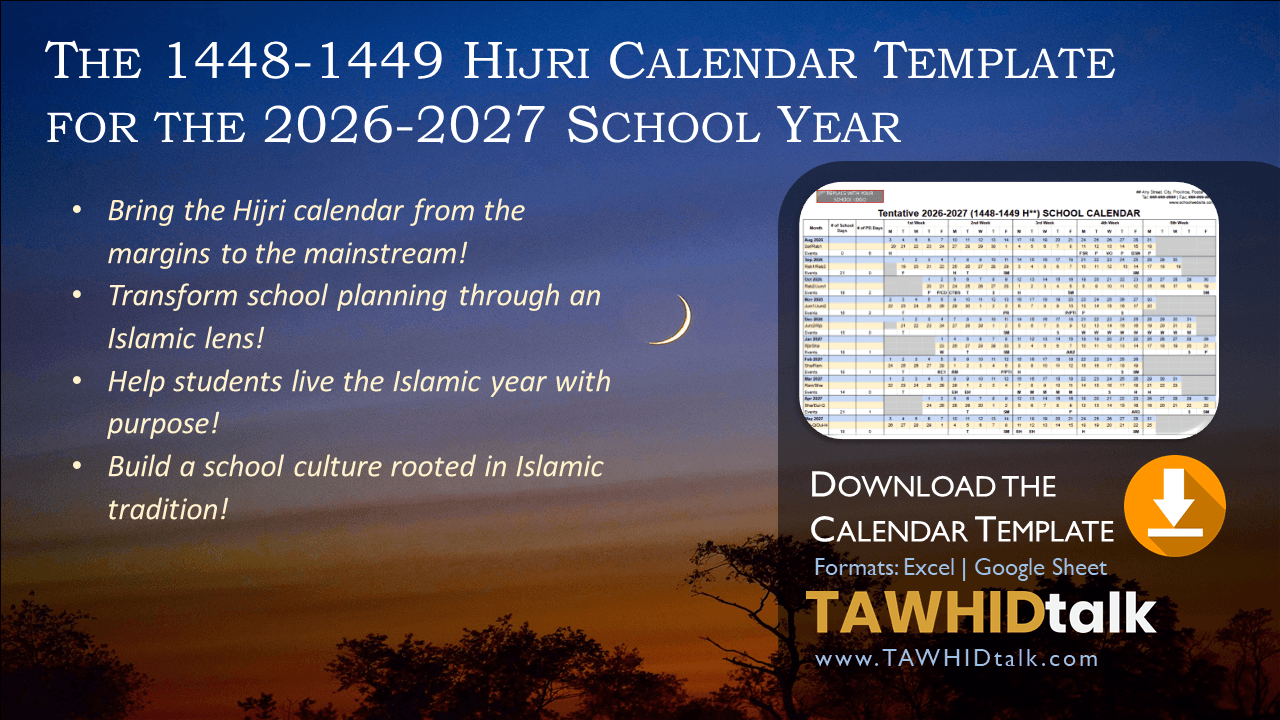
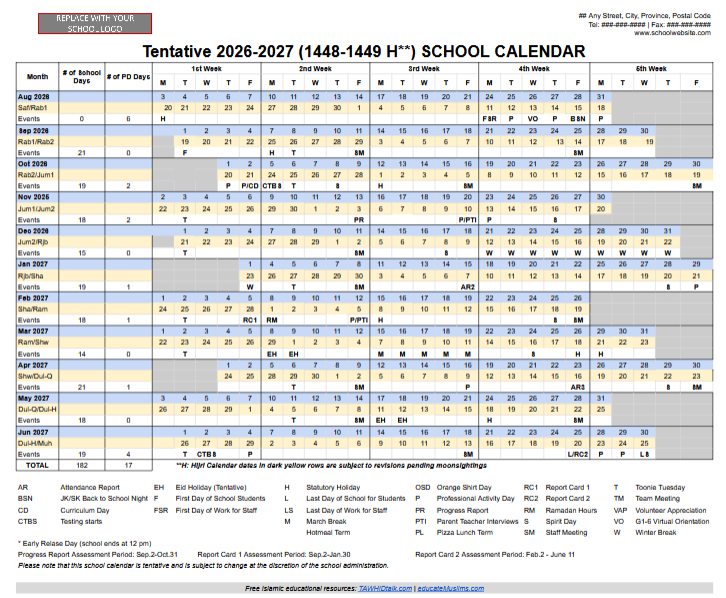
For this reason, I am pleased to share the 1448–1449 Hijri Calendar Template for the 2026–2027 School Year.
Customize by Copying the google Sheet to Your drive
1448-1449 Hijri School Calendar for the 2026-2027 School Year
This template is more than a scheduling tool. It is a practical resource that helps Islamic schools integrate the Hijri calendar into the daily life of the school and reconnect learning with an Islamic worldview.
To better understand the ideas behind this calendar template, I encourage readers to explore the following articles. The first introduces the rationale for integrating the Hijri calendar into the life of an Islamic school, while the second examines how the calendar itself reflects and reinforces a particular worldview. Together, they provide the educational and philosophical foundation for the 1448–1449 Hijri School Calendar Template.
In this inaugural episode, we explore Tawhid beyond a strictly theoretical or theological construct, framing it as an active, unifying worldview. We examine how centering Tawhid shapes personal ethics, community dynamics, modern education, and spiritual practice in everyday contemporary life.
Key Timestamps & Topics
[00:00] Introduction
[00:47] What does Islam say about the world we areliving in?
[01:19] Beyond Rituals: Why Tawḥīd is a complete framework for life, not just abstract theology.
[01:49] I am your host Mohammed Saleem.
[02:31] Today we live in a world with competing ideas about what it means to be human.
[03:01] What happens when we examine ideas through the lens of Tawhid – the Oneness of Allah (subhanahu wa ta’ala)?
[04:59] Ja’afar ibn Abi Talib’s (ra) speech to the Negus, the King of Abyssinia
[07:16] How Tilawah, Tazkiyah, ‘Ilm-ul-Kitaab, and Hikmah (Qur’an 62:2) provide a blueprint for personal and educational reform.
[08:44] What can you expect when you visit TAWHIDtalk.com?
Core Takeaways & Themes
Allah is the ultimate source of all knowledge
Islam teaches us to see all knowledge—whether revealed or discovered through observation, experience, and reflection—as ultimately coming from Allah, Al-ʿAlīm, the All-Knowing. This understanding shapes not only what we learn, but how and why we learn.
Knowledge is a gift—and a reason for gratitude
From teaching Adam عليه السلام “the names of all things” (Qur’an 2:31) to giving humanity hearing, sight, and intellect (Qur’an 16:78), Allah reminds us that our capacity to know is itself a blessing. Knowledge should therefore lead us to shukr (gratitude).
The value of knowledge depends on its purpose and impact
The Prophet ﷺ taught, “Indeed, actions are according to intentions” (Sahih al-Bukhari 1; Sahih Muslim 1907) and sought refuge from “knowledge that does not benefit” (Sunan an-Nasa’i 5470) and sought Allah’s protection from “knowledge that does not benefit” (Sunan an-Nasa’i, 5470). True learning shoudl be pursued for Allah’s sake and should benefit others.
True knowledge produces humility and transformation
The more we recognize the limits of human knowledge—“you have been given but little knowledge” (Qur’an 17:85)—the more knowledge should cultivate humility and awe of Allah. As the Qur’an states, “Of all of Allah’s servants, only the knowledgeable are truly in awe of Him” (Qur’an 35:28). Knowledge is meant to transform our thoughts, intentions, character, and actions.
A Qur’anic Duʿāʾ for Lifelong Learning
The episode concludes with the beautiful supplication Allah taught the Prophet ﷺ:
رَّبِّ زِدْنِي عِلْمًا My Lord! Increase me in knowledge.” — Qur’an 20:114
The episode invites educators, parents, and lifelong learners to pursue knowledge that is sincere, beneficial, humbling, and transformative—and that draws us closer to Allah.
References and Resources
Qur’an 2:31 — Allah teaches Adam عليه السلام “the names of all things.”
Qur’an 2:282 — “Be mindful of Allah, for Allah teaches you. And Allah has perfect knowledge of all things.”
Qur’an 6:59 — Allah’s complete knowledge of the seen and unseen.
Qur’an 16:78 — Allah gives humanity hearing, sight, and intellect and calls us to gratitude.
Qur’an 17:85 — “…you have been given but little knowledge.”
Qur’an 20:114 — “My Lord! Increase me in knowledge.”
Qur’an 35:28 — “Of all of Allah’s servants, only the knowledgeable are truly in awe of Him.”
Qur’an 98:7–8 — The connection between faith, righteous action, and the reward of those who fear their Lord.
Sahih al-Bukhari 1 — “Actions are according to intentions.” This foundational hadith emphasizes the importance of niyyah (intention) in determining the value of our actions.
Sunan an-Nasa’i 5470 — Seeking refuge from knowledge that does not benefit. The Prophet ﷺ supplicated: “O Allah, I seek refuge with You from knowledge that is of no benefit…” The hadith connects beneficial knowledge with humility and spiritual growth.
Forty Hadith an-Nawawi, Hadith 1 — Actions Are by Intentions. A useful introduction to the Islamic principle of niyyah referenced in the episode. 40 Hadith Nawawi — Hadith 1
Sunan an-Nasa’i 5470 — Knowledge That Does Not Benefit. The full hadith and Arabic text are available through Sunnah.com. Sunan an-Nasa’i 5470
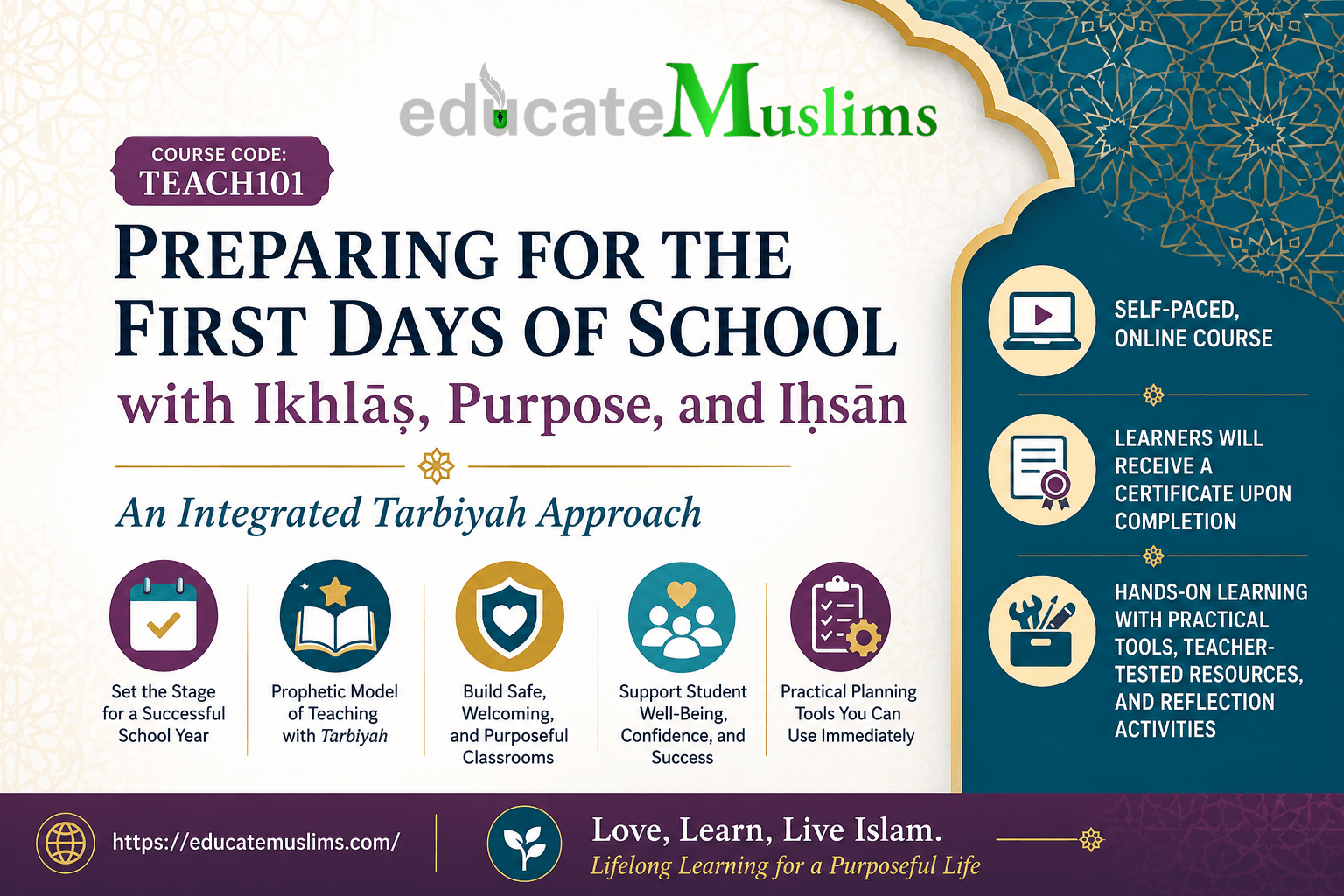
The beginning of a new school year is filled with preparation. Classrooms are organized, lessons are planned, resources are gathered, and procedures are reviewed. But for a Muslim teacher, there is another kind of preparation that matters just as much: preparing the heart and purpose behind the work.
Before we ask, “What will I teach?”, we should ask, “Why am I teaching?”
Before we establish classroom rules and routines, we should consider, “What kind of relationship do I want to build with my students?”
And before the first lesson begins, we should remind ourselves that teaching is not simply a profession. When approached with the right intention, it can be an act of worship and a means of nurturing the next generation.
Preparing for the First Days of School Through Tarbiyah
The course brings together Islamic principles, the Prophetic model of tarbiyah, and insights from educational research to help Muslim educators approach the first days of school with greater intentionality.
At the heart of the course are three qualities:
Ikhlāṣ — Sincerity
Renewing our intentions to teach sincerely for the sake of Allah and how we can make our teaching an act of ‘ibaadah (worship).
Purpose — Direction
Understanding that education is about more than academic achievement. It is also about nurturing students, developing character, and helping them grow toward their potential.
Iḥsān — Excellence
Striving to do our work with care, excellence, and awareness that Allah sees how we fulfill our responsibilities.
The course explores practical questions that every teacher faces at the beginning of the year: How do we establish positive relationships with students? How do we create clear expectations and routines? How do we motivate students? How can our classroom environment reflect Islamic values?
These are not merely classroom-management questions. They are tarbiyah questions.
The first days of school can set the tone for everything that follows. They are an opportunity to communicate to students—not only through what we say, but through how we teach, listen, organize, correct, encourage, and care—that learning is meaningful and that every student has value.
Start the School Year with Intention
Whether you are a new teacher preparing for your first classroom or an experienced educator looking for a meaningful reset, TEACH101 offers an opportunity to pause, reflect, and prepare for the year ahead through an Islamic lens.
Because effective teaching begins long before the first lesson.
It begins with the heart.
Explore TEACH101: Preparing for the First Days of School with Ikhlāṣ, Purpose, and Iḥsān: An Integrated Tarbiyah Approach to Teaching and prepare not only to teach—but to nurture, inspire, and serve with purpose.
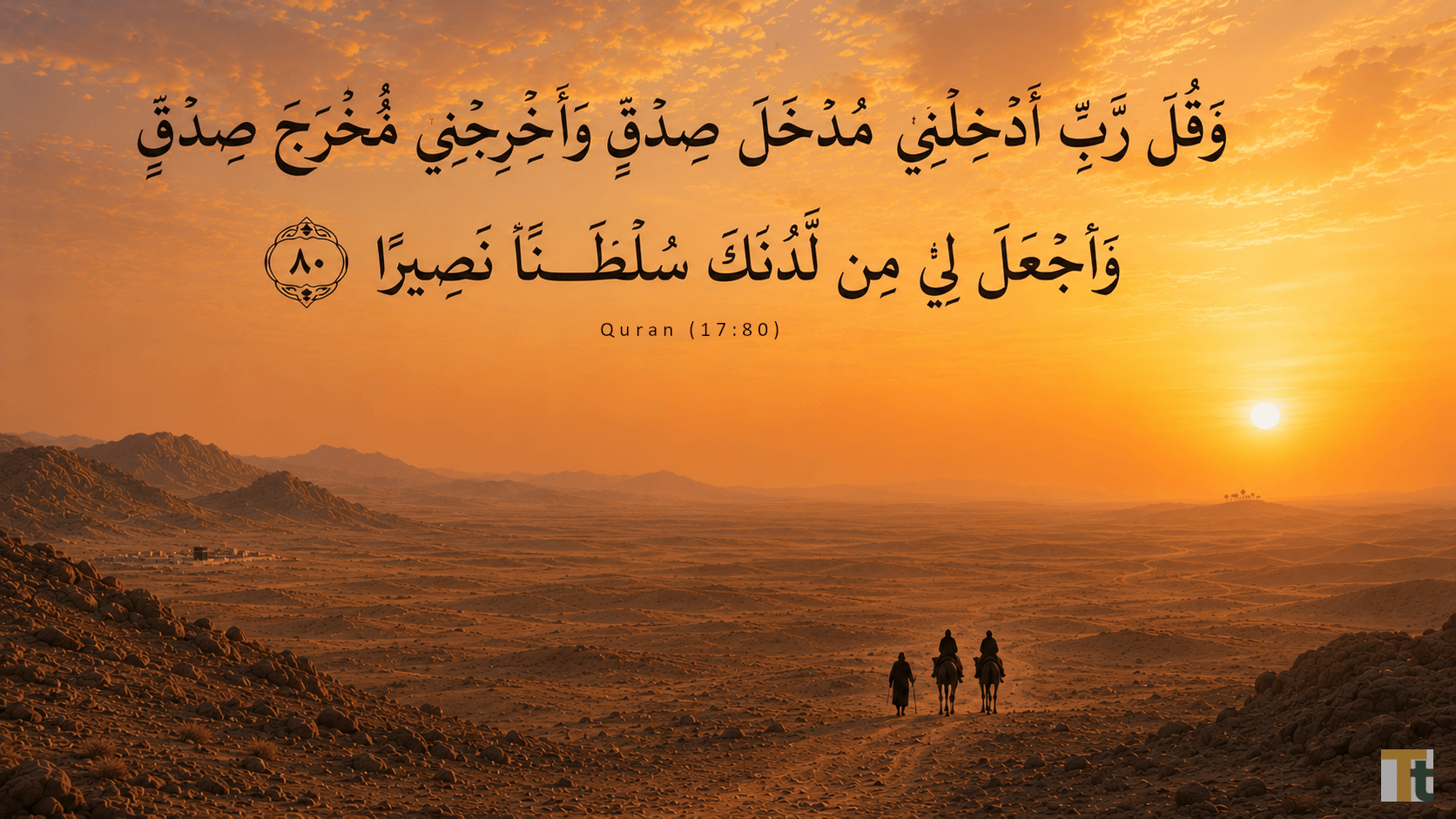
The Hijrah of Prophet Muhammad ﷺ was more than a physical migration—it was a spiritually guided transition that teaches Muslims how to navigate major life changes with sincerity, purpose, and reliance on Allah. As we move from the school year into summer, the Qur’anic duʿāʾ revealed in connection with the Hijrah (Qur’an 17:80) provides a powerful framework:
"My Lord! Grant me an honourable entrance and an honourable exit and grant me a supporting authority from Yourself."
Allah did not simply command the Prophet ﷺ to migrate; He taught him to make duʿāʾ first, demonstrating that meaningful transitions begin with preparing the heart before taking action. The surrounding verses highlight three essential anchors during times of change: salah, duʿāʾ, and the Qur’an.
A key lesson from the duʿāʾ is the concept of ṣidq (truthfulness and sincerity)—ensuring that both our departure from one stage of life and our entrance into another are rooted in sincere intentions and actions that please Allah.
For educators, this means: 1. Exiting the school year with integrity by fulfilling responsibilities, resolving conflicts, and leaving on good terms. 2. Entering summer with purpose through spiritual renewal, family connection, reflection, and meaningful goals. 3. Relying on Allah for guidance and success rather than depending solely on planning or personal effort.
For families, this means: 1. Seeking Allah's guidance through du'a 2. Protecting Salah before the schedule changes 3. Making Qur'an the companion for the summer 4. Creating a Technology Plan before screens fill the space 5. Connecting with Allah through the outdoors 6. Learning together through shared experiences
The Hijrah reminds us that every transition is an opportunity for growth and closeness to Allah. When we approach change with sincere intentions, duʿāʾ, and tawakkul, Allah opens the door to greater blessings and success than we can foresee.
Introduction: Why Transitions Matter in Islam and in Life
As another Hijri year begins, we are reminded of one of the most significant moments in Islamic history—the Hijrah of the Prophet Muhammad ﷺ from Makkah to Madinah. This journey, which took place over 1,400 years ago, was not just a physical migration but a turning point that reshaped the future of the Muslim Ummah.
Interestingly, the anniversary of the Hijrah comes at a time when many are also entering a major transition: the end of the school year and the beginning of summer.
While these may seem like two very different contexts, the Qur’anic guidance surrounding the Hijrah offers timeless lessons on how to navigate change with purpose, intention, and reliance on Allah. How we approach transitions determines not only what we leave behind, but also what we are preparing ourselves for.
With the start of another Hijri year, we are reminded of the pivotal journey of our beloved Prophet Muhammad from Makkah to Madinah one thousand four hundred and forty eight years ago. Coincidentally it is coming as we close off another school year and transition into summer. How we navigate this transition can significantly impact what we are heading towards and what we are leaving behind us. The Hijrah of Prophet Muhammad teaches us important lessons that we can use to ensure this transition occurs in a way that is of greatest benefit to us.
The Hijrah: A Time of Hardship Before Relief
Before the Hijrah, the Prophet ﷺ and the early Muslims faced intense and escalating persecution in Makkah. The Quraysh subjected them to physical torture, social isolation, economic boycott, and the loss of tribal protection.
During this period, the Prophet ﷺ also experienced profound personal loss in what became known as the Year of Sorrow, when his beloved wife Khadijah (ra) and his uncle Abu Talib passed away. Seeking support in Ṭāʾif, he was rejected and even stoned until his blessed feet bled.
Despite these hardships, the message of Islam continued to grow. As more people embraced faith, opposition increased, eventually leading the Quraysh to plot the assassination of the Prophet ﷺ.
At this critical moment of pressure and uncertainty, divine guidance came—not as a simple command, but in the form of a powerful duʿāʾ.
The Command to Make Hijrah: A Duʿāʾ, Not Just an Order
Allah instructed the Prophet ﷺ and the believers to migrate. Imam Ahmad recorded that Ibn `Abbas said: The Prophet was in Makkah, then he was commanded to emigrate, and Allah revealed the words:
And say, “My Lord! Grant me an honourable entrance and an honourable exit and grant me a supporting authority from Yourself.” (17:80)
At-Tirmidhi said, “This is Hasan Sahih.”(Tafsir Ibn Kathir of Surah Al-Isra Verse 80, n.d.).
Although Allah could have directly commanded the Hijrah, He instead framed it as a duʿāʾ, revealing a profound pedagogical strategy. Major transitions are not merely logistical decisions; they are spiritual journeys that require preparation of the heart. By inviting the Prophet ﷺ and the believers to seek guidance through prayer, Allah gently redirected them toward a difficult yet necessary path. The language of duʿāʾ nurtures acceptance, strengthens tawakkul, and transforms reluctant obedience into willing submission. Meaningful change begins with an internal realignment of the heart toward Allah’s wisdom and plan.
The Power of Duʿāʾ in Times of Transition
Leaving Makkah was not easy. It was the birthplace of the Prophet ﷺ, the home of the Kaʿbah, and deeply beloved to the believers. Naturally, leaving such a place would be emotionally difficult—even when it was necessary.
It was difficult for the Prophet and the Muslims to leave Makkah. They loved Makkah. This was not only their ancestral home but also a Holy City that housed the Ka’aba, the first house built to worship Allah (swt). Who had more right to be there and be its caretakers than the Messenger of Allah and those who believed in him? None!
Rather than commanding immediate departure, Allah first taught them to make duʿāʾ for it.
This is where we see the wisdom of divine تربيه (tarbiyah): Allah prepared their hearts before moving their bodies.
Duʿāʾ, therefore, is not only a request for help—it is an act that aligns the heart with Allah’s decree. It softens resistance, builds acceptance, and transforms hardship into surrender.
For anyone facing uncertainty—whether a career shift, a life change, or even the transition from school to summer—the lesson is clear:
Seek guidance and help from Allah with duʿāʾ before action, and put our tawakkul (trust) in Allah.
The Qur’anic Framework for Navigating Life’s Transitions
The duʿāʾ for Hijrah in Surah Al-Isrāʾ (Qur’an 17:80) is not presented in isolation. Significantly, it is sandwiched between verses emphasizing salah and the Qur’an, revealing a powerful strategy for seeking Allah’s help during times of transition.
Before the duʿāʾ, Allah commands the Prophet ﷺ to establish prayer followed by the encouragement to engage in night prayer:
Observe the prayer from the decline of the sun until the darkness of the night and the dawn prayer, for certainly the dawn prayer is witnessed ˹by angels˺. And rise at ˹the last˺ part of the night, offering additional prayers, so your Lord may raise you to a station of praise. (Qur’an 17:78-79).
We send down the Quran as a healing and mercy for the believers, but it only increases the wrongdoers in loss. (Qur’an 17:82).
The placement is intentional. When facing uncertainty, change, or difficult decisions, believers are taught to anchor themselves in three things: salah, duʿāʾ, and the Qur’an. Prayer strengthens our connection with Allah, duʿāʾ expresses our dependence upon Him, and the Qur’an provides the guidance, healing, and clarity needed to move forward with confidence.
This framework echoes Allah’s instruction in Surah Al-Baqarah:
And seek help through patience and prayer. Indeed, it is a burden except for the humble—(Quran 2:45)
True tawakkul is not passive resignation; it is actively turning to Allah through consistent worship, patient perseverance, and sincere supplication while taking the necessary steps forward.
Allah then describes those who can embody this mindset:
those who are certain that they will meet their Lord and to Him they will return. (Qur’an 2:46)
Viewing life as a journey toward our meeting with Allah transforms how we navigate every transition. Career changes, family milestones, loss, uncertainty, and new beginnings are no longer distractions from our purpose but opportunities to draw closer to Him.
When our ultimate destination is clear, temporary detours cannot derail us. A heart anchored in the Qur’an, strengthened through sabr and salah, and guided by duʿāʾ remains steadfast through every season of life, always moving toward its final return to Allah.
صِدْق – Sidq (Truthfulness) in Intentions and Actions
A key concept in the dua (Qur’an 17:80) is the word صِدْق – ṣidq (truthfulness, sincerity, integrity) to describe the entrance into Al-Madinah and the exit from Makkah.
Scholars such as Maulana Mufti Muhammad Shafiʿ in his tafsir, Ma’riful Qur’an, explain that ṣidq here refers to actions that are correct both outwardly and inwardly—aligned with Allah’s pleasure in both intention and execution.
This reminds us that the Hijrah was not just a physical migration; it was a spiritually intentional transition, free from emotional reaction or attachment to place.
This concept is reinforced elsewhere in the Qur’an:
قَدَمَ صِدْقٍ – honorable standing (10:2)
لِسَانَ صِدْقٍ – truthful reputation (26:84)
مَقْعَدِ صِدْقٍ – seat of honor (54:55)
In every case, ṣidq reflects excellence rooted in sincerity. In other words, as per Maulana Mufti Muhammad Shafi’, Allah (swt) is guiding them to pray, “O Allah, may my entry into Madinah turn out to be good and smooth, without having to face anything unpleasant and unwelcome on arrival there. And may my exit from Makkah be good and smooth, without being entangled in love of country and home.”
Checking the sincerity of our intentions by making sure our decisions during transitions are for the right reasons is an important mindset to have.
Applying This to Educators: Transitioning from School to Summer
Just as the Hijrah required intentionality, educators can approach the end of the school year with the same spiritual mindset.
1. Honorable Entrance into Summer
Allah commands the Muslims in this du’a to pray for an honorable entrance before the exit even though logic dictates that we first ask for relief from circumstances that are currently surrounding us. However, our destination may have more uncertainties than what we are leaving behind. Therefore, it is fitting that we first seek Allah’s guidance in taking us to a place or situation that is better (with higher objectives) than what we are leaving behind. Rather than viewing summer as simply “time off,” it can be approached with purpose:
Set meaningful personal and professional goals
Strengthen family and community relationships
Engage in reflection and spiritual renewal
Re-energize for future teaching and learning
2. Honorable Exit from the School Year
Allah ordered the Prophet ﷺ and his companions to ensure their exit out of Makkah was based on honorable principles despite the persecution and oppression they had endured for thirteen years in Makkah. So the Prophet made sure he returned back to the rightful owners what they had entrusted him with and the Muslims left in peace without causing any harm or mischief.
Closing the year with integrity matters just as much:
Resolve conflicts and misunderstandings
Ensure fairness in student assessment
Complete responsibilities with care and accountability
Avoid burning bridges, even in stress or fatigue
Like the companions of the Prophet ﷺ, educators are reminded to end cycles with ihsan, not just completion.
Families should pay special attention to the transition from school to summer. The schedules and structures that once supported our daily routines suddenly shift, and without intentional planning, can disrupt our life’s goals and priorities. The lessons of the Hijrah remind us that transitions require preparation, reliance upon Allah, and a commitment to keep our priorities at the center.
Seek Allah’s Guidance through Du’a: Start making du’a as a family for guidance to make the best of the summer days. This will incline the hearts of all family members to commit to using the summer days as productively as possible.
Protect Salah Before the Schedule Changes: When routines become more flexible, prayer times can become more vulnerable. During school breaks, vacations, and unstructured days, it is easy to delay salah or lose the rhythm that previously anchored the day. Revisit your family schedule to determine if it needs to be realigned to the salah times.
Make the Qur’an the Companion of the Season: With fewer external demands competing for attention, families can create special opportunities to reconnect with Allah’s words. Set a family reading goal, set time to recite the Qur’an together. Have a memorization goal. Increase understanding of the Qur’an by reading tafsir of some surahs or by watching some related videos together as a family.
Create a Technology Plan Before Screens Fill the Space: One of the greatest challenges of unstructured time is excessive screen use. Without clear expectations, technology can quickly consume hours. Set daily screen-time boundaries. Establish screen free zones (salah, lunch, dinner, bed time, etc.). Collaboratively develop the family’s technology guidelines.
Connect with Allah Through the Outdoors: The natural world is filled with signs of Allah’s power, mercy, and creativity. Time outdoors offers a chance to slow down, reflect, and reconnect with our Creator. Plan outdoor family activities such as hiking, fishing, canoeing/kayaking, camping, etc.
Learn Together Through Shared Experiences: One of the most meaningful ways to use transitional periods is to learn together as a family. Learning should not be limited to books and lectures; hands-on experiences often create the deepest memories and most lasting lessons. Plan family activities throughout the summer to reconnect and strengthen family relationships.
Trusting Allah in Every Transition
The du’a continues:
وَاجْعَل لِّي مِن لَّدُنكَ سُلْطَانًا نَّصِيرًا
“And grant me from Yourself supporting authority.”
Qatadah (ra) explains that the Prophet ﷺ fully recognized that success in his mission could not come from personal strength alone. He turned to Allah for divine support, protection, and empowerment.
This teaches a foundational principle:
True strength is not found in skills, systems, or support networks alone—but in reliance upon Allah.
As we transition into summer, this is a powerful reminder to begin with tawakkul (trust in Allah), not just planning and productivity.
The Divine Response: Truth Prevails
Allah responds to the Prophet’s duʿāʾ with reassurance:
And declare, “The truth has come and falsehood has vanished. Indeed, falsehood is bound to vanish.” (Qur’an 17:81)
This was essentially the glad tidings Allah gave to the Prophet and the Muslims that one day they will return to Makkah victorious. And these were the words that the Prophet was uttering as he smote down the 360 idols one by one with his staff on that promised day.
This declaration is not only historical—it is a timeless principle: when transitions are grounded in truth, sincerity, and reliance on Allah, success follows in ways we may not immediately see.
Conclusion: A Duʿāʾ for Every Transition
The Hijrah teaches us that transitions are not just endings—they are sacred beginnings shaped by intention, duʿāʾ, and trust in Allah.
As educators step into summer, the same prophetic guidance applies:
Begin with duʿāʾ, not anxiety
Enter with purpose, not passivity
Exit with integrity, not neglect
Rely on Allah, not just on planning
May this summer be a season of honorable entrance, honorable reflection, and renewed strength through Allah’s guidance and may our exit from school be blessed with khair, forgiveness, and goodwill and may Allah grant us the strength, power, and resources to do so.
There are many resources out there that share tips on how to get back on track. I must say that they have lots of good tips but they come from a very secular and materialistic paradigm and are mixed with elements that may be contrary to the goals of tarbiyah. I wanted to share tips that will not only help you to get back on track but to do so by reconnecting with our Islamic values and priorities.
Tip 1: Reflection Time (Tafakkur تفكر)
Winter breaks are often an unstructured time for children, and many want to just unplug from any “brain heavy” activities. Additionally, the fast paced, digitally connected lives we live do not really afford us the time and space to reflect. Provide opportunities during the first day back for students to reflect by planning a variety of reflection activities. Reflections should focus on intentions (purpose), experience over the break, reality check and goals moving forward.
Renew Intentions (Niyyah نية)
Most of us are aware of the famous hadith narrated to us by Omar Ibn Al-Khattab (ra) in which the Prophet (saw) highlighted how our actions are judged by our intentions:
It is narrated on the authority of Amir al-Mu’minin (Leader of the Believers), Abu Hafs ‘Umar bin al-Khattab (may Allah be pleased with him), who said: I heard the Messenger of Allah (peace be upon him), say: “Actions are according to intentions, and everyone will get what was intended. Whoever migrates with an intention for Allah and His messenger, the migration will be for the sake of Allah and his Messenger. And whoever migrates for worldly gain or to marry a woman, then his migration will be for the sake of whatever he migrated for.” Related by Bukhari & Muslim.
Many people focus on their external states (actions) and neglect their internal states (intentions). This hadith emphasizes the importance of maintaining that balance between our internal and external states. It is also interesting that the Prophet ﷺ is using a transition point (migration) to illustrate the importance of renewing our intentions during transitions. As we transition from the break back to school, it is important that we reflect on this hadith with our students and renew our intentions using this recommended outline:
Why am I doing what I am doing? Is it to please Allah ﷻ or for another reason?
Rewards for seekers of knowledge: Reminding ourselves and our students of the great reward and honor Allah ﷻ has kept for the merchants of knowledge will put things in the right perspective for us and help us to realign our intentions for the right reasons. The chapter in Riyad us-Saliheen by Imam Al-Nawawi on Seeking Knowledge is an excellent read on this topic.
• Riyā (رياء) – Showing off: Nothing ruins sincerity of our intentions; hence, makes our actions worthless, as much as showing off! The social media culture we live in makes us thrive on self-aggrandizement. Shaytan will present us with many opportunities as we come back to school to “toot our horn” in a variety of ways. Allah ﷻ has cursed in Suratul Ma’oon (Quran Surah 107) those who show off while doing the most important act of worship in Islam, salah. Reflecting on this Surah is a good exercise and perhaps even a lesson that we can teach our students upon our return to school. An excellent du’a to make for protection against riya is:
الَّلهُمَّ إِنِّي أَعُوذُ بِكَ أَنْ أُشْرِكَ بِكَ وأَنا أَعلَمُ وأَستَغفِرُكَ لما لا أَعلَمُ
Allahumma inni a’udhu bika an ushrika bika wa ana a’lamu wa astaghfiruka lima la a`lamu O Allah I seek refuge in You from knowingly associating partners with You, and I seek Your forgiveness for that which I do unknowingly.
Reflect Over the Winter Break Experience
There are important lessons to be learned from the winter break. Provide opportunities for students to reflect on their experience over the break and to share it with others. Many students will be bursting with enthusiasm to share their experience while others may not want to share because they feel it was boring. Therefore, it is important for teachers to structure this reflection activity carefully in a manner that doesn’t put anyone “on the spot”.
There are many “winter break reflection” activities out there that view the whole experience from a very materialistic lens…
There are many “winter break reflection” activities out there that view the whole experience from a very materialistic lens: the amazing food eaten, new clothes and toys acquired, the exotic and “expensive” places visited, the thrills experienced, etc. Not everyone can afford these things, making some students feel left out. Moreover, the teacher has a duty to guide students to reflect spiritually over their experience and to guide them towards a more conscientious lifestyle.
Here are some guiding questions for student reflection from an Islamic perspective:
Describe ways you connected with Allah ﷻ over the break.
Describe one encounter you had with the Qur’an over the break.
Did you visit a masjid you’ve never visited before? Share your experience.
Did you help someone over the break? How did it make you feel?
Did you read a new book, if so tell us about it.
Did you do something good that you’ve never done before?
Did you learn a new skill?
I’m sure you can come up with many other questions and items that can be included in reflection activities to position them in a way that facilitates tafakkur (تفكر), spiritual reflection. Please share them in the comments if you do.
Reality Check and Goal Setting
Tap into the popular culture of new year resolutions to motivate students to set targets for their continued development and growth. Start with a reality check with student self-assessments in a variety of areas:
Peer relationships
Curricular content/Academic Goals
Problem solving (I don’t mean math problems)
Learning skills and work habits
Have students set goals for areas that they think are not doing so well in. You can have this exercise spread over the first 2-3 days to ensure there is a gap for reflection between the self-assessment and goal setting. A Single Point Rubric is a great way to structure student self-assessment.
Set goals as a class and guide students to set individual goals after conducting a self-assessment. Make sure the goals students are setting are achievable. Help them to understand the difference between a wish and a goal. The popular SMART framework for goal setting mostly highlights individual agency and doesn’t really focus on tawakkul (توكل), relying on Allah ﷻ for the results. I saw an Islamic adaptation of this framework at the Houston Qur’an Academy called “Qur’an SMART” that I thought was very smart (no pun intended)! I’ve built on this idea a bit more to align the SMART framework with the concept of tawakkul (توكل) in Islam:
TIP 2: Give Hope by Making it a Successful First Day Back
Effective teachers give hope to their students. This is how Allah ﷻ describes the Prophet ﷺ. Design the first day back to provide maximum opportunities for students to succeed. Some students will be anxious going back to school. Do not overplan the first day back because students will be tired and may need some time to get back into the swing of things.
This is a good time to review the major themes, concepts, and skills covered in your class. Design a game to review them so it is more interactive. Here are some ideas to get you started that are more socially engaging than Jeopardy style or Kahoot! style games:
The Hot Seat: One student sits facing the class. Write a vocabulary word on the board behind them. The student in the “hot seat” calls upon 3 different students for clues to guess the word. Keep changing the “hot seat” student for any wrong guesses.
Family Feud: Divide the class into groups. For each round, one student from each group goes against a student from another group to answer a review question. Team points are awarded for correct answers. All students are expected to fill out their journals/worksheet with the right answers and submit for individual points. This will keep everyone engaged.
Hot Potato: Students sit in a circle to pass the soft toy around the circle. Randomly ask a student a review question that they need to answer before the soft toy comes back to them. If they answer correctly before the soft toy arrives then they continue to sit in the circle; otherwise, they must go into the hot pot (middle of the circle). The soft toy continues to get passed around for the next question. If a student answers incorrectly then you can give a chance for the students in the hot pot to answer the question so they can get out of the hot pot. Warning: this game can get rough so lay down some rules and communicate these expectations clearly to all before starting the game.
Headbands: Write a review term on a post-it-note and stick it on students’ foreheads. The goal is to figure out what the term is based on clues from their team members/classmates.
Check out more fun review activities and classroom games at Teachhub.com.
Student-teacher relationships and peer relationships have the greatest impact on student motivation and building the classroom community is vital for setting the stage for success for the remainder of the year.
Tip 3: Strengthen Relationships
Students have been away from each other for a while and would want to connect after the break. This is also an excellent opportunity to strengthen existing relationships and to forge new ones or positive directions for the bumpy ones. Student-teacher relationships and peer relationships have the greatest impact on student motivation and building the classroom community is vital for setting the stage for success for the remainder of the year. So, dedicate a portion of the day to activities that facilitate bonding between you and the students and between the students. Many of the activities I’ve suggested above for the other tips provide opportunities to form and strengthen relationships.
A great activity to reconnect with others spiritually is through the congregational prayers that most Islamic schools observe for Zuhr. If your school doesn’t have this then plan on having one in your classroom. Remind students during the salah, not only to connect with Allah ﷻ but also with each other by making du’a for each other during salah. If you are unable to have congregational prayers then at least have a dua’ session where anyone in the class can make dua’ and all of us say “aameen” to it. This will join our hearts in love for the sake of Allah ﷻ.
Here’s a beautiful du’a to make for strengthening relationships that was often made by Abdullah ibn Masu’d ؓ is:
Allahumma allif baina qulubina, wa aslih dhata bainina, wahdina subulas-salam, wa-najjina minad-dhulumati ilan-noor O Allah! Reconcile our hearts, amend what is between us, guide us to the paths of peace, save us from the darkness [and admit us] to light!
Tip 4: Review Procedures and Expectations
The long, unstructured time or different structured time away from school during the winter break can make even the most self-disciplined students rusty in the school and classroom routines you worked so hard to establish. Maintain these routines. Knowing what to do when provides a sense of security and comfort to students, especially if they are coming from a chaotic home environment.
This is a good time to go over the procedures and expectations with your students. Expectations (rules, consequences, and rewards) should be reviewed as early in the day as possible. Procedures should be reviewed throughout the day as the time comes to observe them.
Instead of the “chalk and talk” or the “sage on the stage” approach, play an interactive game to review the expectations and procedures. You can create a Kahoot! game or a Jeopardy style game using PowerPoint or Google Slides. An alternative to the Kahoot! Platform is Aha Slides.
The tips shared here can transform teachers’ mundane actions into meritorious deeds worthy of Allah’s ﷻ reward. Use these tips as an outline to create your “1st Day Back Lesson Plan” or even the “1st Week Back Lesson Plan”. Make sure you begin your day and your class with bismillah and by making du’a for your students and for yourself (do this collectively with your students). May Allah accept from all of us. May Allah grant you and your students success every step of the way!
Time is a creation of Allah (swt). It is one of the greatest blessings of Allah (swt) and the ability to measure it is a sign of Allah (swt) and of His (swt) Divine order:
It is He who made the sun radiant, and the moon a light, and determined phases for it—that you may know the number of years and the calculation. Allah did not create all this except with truth. He details the revelations for a people who know. (Quran 10:5).
The Hijri Calendar
The Hijri Calendar is a lunar-based calendar that begins with the Hijrah, the migration of Prophet Muhammad ﷺ from Makkah to Madinah. The Hijrah marked a turning point in Islamic history and laid the foundation of the first Muslim community in Al-Madinah. The Hijri calendar was instituted during the caliphate of Umar ibn al-Khattab (RA) to offer Muslims a distinct system for measuring time—one that aligns with the divine rhythm set by Allah (swt) from the beginning of creation:
The number of months, according to Allah, is twelve months—in the decree of Allah—since the Day He created the heavens and the earth, of which four are sacred. This is the correct religion. So do not wrong yourselves during them. And fight the polytheists collectively, as they fight you collectively, and know that Allah is with the righteous. (Quran 9:36).
Integrating the Hijri Calendar in the School Calendar
Using the Hijri calendar as the main blueprint for the school calendar will help us to strengthen the Muslim identity of our students. A Hijri based school calendar will help us to internalize Islamic values and heritage as it will revolve around important Islamic milestones and markers throughout the year. It will also create opportunities for a thematic and value-based learning.
However, simply tacking Eid onto a Gregorian calendar isn’t enough. True integration requires rethinking the structure of school calendars so that Muslim students can live, learn, and grow in harmony with the Islamic worldview and identity. Please see my previous blog post titled “Re-framing the school calendar within the Islamic worldview” for a sociopolitical history of school calendars and an in-depth analysis of its impact on student learning.
2025-2026 School Year Template for the 1447-1448 Hijri Calendar
Template Features
The template can be downloaded in Excel or Google Sheet formats. You can customize the template as follows:
Insert school name, address, contact information
Automatically calculate the number of school days per month and yearly total
Automatically calculate the number of professional development days per month and yearly total
Include school events
Mark Islamic events
How do you plan to use the 1447–1448 Hijri Calendar template in your school? Share your thoughts, questions, or suggestions in the comments below — your feedback helps us grow and serve you better!
Teaching is demanding work (more on this later). Winter break comes just as we feel our energy reserves are coming to an end. Us and our students start looking forward to some time to relax and renew ourselves before school resumes in January. There are many resources online for teachers on mental health and self-care during the break. Most highlight how to rejuvenate ourselves by disconnecting from the daily grind and by pampering ourselves through a variety of ways.
Before you jump headfirst into these guilty pleasures, I am going to ask you to step back a little bit and ask the following: What would the Prophet Muhammad ﷺ, the best teacher, do if he ﷺ had a winter break? I know! I know! He ﷺ lived in the desert and wouldn’t have had a winter break. In fact he did not have any type of break at all throughout his ﷺ life! But just stay with me. How would he ﷺ advise us to renew ourselves? What would he ﷺ have us do? If you are still interested then keep on reading to find out the things every Muslim teacher should do during winter break to revitalize themselves.
Summary
Use the winter break not just for rest, but to spiritually, mentally, and socially revitalize yourself by deepening your relationship with Allah, reflecting on your purpose, strengthening good habits, managing your time wisely, and connecting with others.
Key Points:
Teaching is demanding: Teachers give a lot emotionally and mentally; winter break is vital for recharging.
Renew spiritual focus:
Reflect on life and faith — especially through prayer (e.g., tahajjud) and Qur’anic contemplation (tadabbur, tafakkur).
Strengthen your connection with the Qur’an and understand your purpose in teaching.
Develop sabr (patience): Use fasting and other acts of worship to build long-term and short-term patience
Renew intentions: Clarify why you teach; align your goals with sincere intentions and reliance on Allah.
Health & habits: Be strategic about sleep and sunnah practices; reduce unnecessary screen time; use time wisely.
Engage in beneficial activities: Reflect outdoors, read beneficial books, memorize useful du’as, and plan constructive routines.
Collective action: Do things with family or community for greater benefit and reward.
Teaching is a continuously ill defined, complex, and dynamic process. During class hours teachers frequently engage with students, supporting them emotionally, counselling them, and guiding them. The work doesn’t stop with the bell. They spend long hours planning, developing instructional materials, and grading assignments outside of classroom hours. They connect with parents, attend staff meetings, and participate in professional development.
But the most demanding work is doing all of the above while ensuring students meet academic standards, perform well, and are happy while doing so. That is mentally and emotionally draining because it requires maintaining a presence of mind, a caring attitude, and lots of sabr (patience and fortitude) despite feeling frustrated and drained. The well known quote,
A good teacher is like a candle, it consumes itself to light the way for others.
summarizes well the nature of teaching. Therefore, taking a break after almost the first half of the year is key in ramping up our energy, enthusiasm, and dedication for teaching. This will put us on top of our teaching game and will benefit our students.
Taking a break is essential for our well being. But what if I told you that doing so will also earn us rewards from Allah ﷻ? Yes, that’s true! But it requires us to approach the break with a certain mindset, intention, and focus in order for it to become a meritorious act of worship. So come along and let’s see how we can do that.
This life is a test
All of us are tested daily in unique ways and are required to tap into our sabr reserves – what I like to call the sabr bank. There may be days when we may find that our sabr reserves are depleted. Allah ﷻ describes this:
Or do you expect to enter Paradise before the example of those who came before you had reached you? Adversity and hardship had afflicted them, and they were so shaken up, that the Messenger and those who believed with him said, “When is Allah’s victory?” Indeed, Allah’s victory is near. (Qur’an 2:214)
For a believer, this life is a series of tests. These tests come in many forms. Sometimes Allah ﷻ tests us with plenty to see if we are grateful. At other times, Allah ﷻ tests us with adversity to see if we observe patience.
We see examples of both in the Qur’an at each end of the spectrum. On one side we see Sulaiman (as) who was given a kingdom the like of which was not given to anyone before or after him. And we see how Sulaiman (as) reached a high rank in front of Allah ﷻ with shukr both in word and action. On the other end of the spectrum we see Ayyub (as) who had everything but then everything was taken away from him and he was tested with loss of wealth, health, and family. He endured patiently until he reached a very high rank in the eyes of Allah ﷻ.
The Prophet ﷺ has said,
Verily, if a servant is destined for a rank he has not achieved by his good deeds, Allah puts him to trial in his body, or his wealth, or his children. Then, Allah makes him endure it until he reaches the rank decreed for him.
Abī Dāwūd 3090
Our Iman is divided into two halves; sabr and shukr. These are like the two wings of a bird. We need them both to have a balanced flight in this life and to reach our home, Jannah!
The importance of sabr (patience and perseverance)
In this post I am going to focus on sabr because, at this time of the year, many of us may feel exhausted and tested beyond our limits and may feel that our sabr reserves are depleting fast! Traditionally, sabr has been divided into three different types:
The acceptance of the decree (the Qadr) of the Almighty when calamity comes in our direction.
The endurance required in order to fulfill the commands of Allah.
The restraint required in order to abstain from the prohibitions of Allah.
These three different types of sabr can be categorized into two types: short term and long term. The sabr we need for the short term is the sabr we need when the decree of Allah ﷻ catches up with us. The sabr we need for the long term is for the remaining two.
The Rocket Analogy
I am going to use the analogy of a rocket to illustrate the difference between the short term sabr and the long term sabr. A rocket usually has two types of burns, the short and fast burn and the long and slow burn. The short and fast burn is intense and allows the rocket to break away from earth’s gravity. The long burn is slow and steady and allows the rocket to reach its destination, even if it is very far. The short term sabr is like the short and fast burn of a rocket. It enables us to immediately break away from the dreariness of this life and connect with Allah ﷻ. The long term sabr is like the long burn of a rocket, it provides the slow but steady momentum we need to reach our final destination.
Short term sabr
Short term sabr is reflexive and comes from repetitive habits that we do on a daily basis such as the wudu and the five daily prayers. That’s why Allah ﷻ in the Qur’an asks us to seek help through prayer and sabr when calamity strikes us:
O you who believe! Seek help through patience and prayers. Allah is with the steadfast. And do not say of those who are killed in the cause of Allah, “Dead.” Rather, they are alive, but you do not perceive. We will certainly test you with some fear and hunger, and some loss of possessions and lives and crops. But give good news to the steadfast. Those who, when a calamity afflicts them, say, “To Allah we belong, and to Him we will return.” Upon these are blessings and mercy from their Lord. These are the guided ones. (Qur’an 2:153-157).
When calamity strikes us, adrenaline kicks in and we are overwhelmed by emotions, and we may lose our presence of mind and not really think straight. It is a moment when we react without thinking. If we have habituated ourselves to connecting with Allah through the five daily prayers then we will reflexively remember Allah and turn to Him ﷻ and say “inna lillahi wa inna ilaihi rajioon!” It is during the first shock that we are expected to demonstrate this type of sabr. This is what the Prophet ﷺ was referring to when he ﷺ said:
Patience is at the first strike of calamity. Patience is at the first strike of calamity. Musnad Abī Ya’lá 6068
Allah ﷻ has kept wudu and the five daily prayers to inculcate in us this type of sabr. The five daily prayers require us to do specific actions in a very specific way. We are required to say certain things at certain times during the prayer. All this repetitive action at least five times a day trains our mind, senses and limbs and creates cognitive and muscle memory and emotional conditioning that is habit forming. These habits done over the years eventually become part of our personality that enables us to react instinctively and reflexively with sabr when calamity strikes us. No wonder Allah ﷻ begins the verses of Suratul Baqarah cited above by saying, “O you who believe! Seek help through patience and prayers.”
Perfect our salah
Many of us pray as we saw our parents praying. For most of us, our knowledge of salah has been casually acquired by imitating others. I call it the “monkey see, monkey do” model of learning! This type of learning is actually very shallow and doesn’t have the depth required to spiritually connect with Allah ﷻ.
Given that salah is such a fundamental and core life process and the impact it has on building our resilience, we need to pay more attention to how and why we pray the way we do and have a solid understanding of each action in salah. We need to make sure we pray as the Prophet ﷺ used to pray so that it truly becomes our mi’raj (ascension) through which we find solace by connecting with Allah ﷻ.
So one of the things we can do this winter break is to refresh and increase our knowledge of salah. A good book to read is the one by Shk. Al-Albaani, the Prophet’s ﷺ prayer described from the beginning to the end as though you see it . If we have children then make it a point to read this together as a family.
Long Term Sabr
Long term sabr, on the other hand, is reflective and comes with a deep understanding of the Qur’an and a deep understanding of who Allah ﷻ is, the ways He ﷻ works in this world and by having a strong belief in the Hereafter. Allah ﷻ provides an example of this in the Qur’an as well:
When Saul set out with the troops, he said, “Allah will be testing you with a river. Whoever drinks from it does not belong with me. But whoever does not drink from it, does belong with me, except for whoever scoops up a little with his hand.” But they drank from it, except for a few of them. Then, when he crossed it, he and those who believed with him said, “We have no strength to face Goliath and his troops today.” But those who knew that they would meet Allah said, “How many a small group has defeated a large group by Allah’s will. Allah is with the steadfast.” And when they confronted Goliath and his troops, they said, “Our Lord, pour down patience on us, and strengthen our foothold, and support us against those who have rejected the Truth.” (Qur’an 2:249-250)
The people of Saul were tested in their long term sabr. Only a few passed the test! That is the nature of long-term sabr. While many may have the short-term sabr and endure the initial shock of a calamity and overcome it, only a few have long-term sabr and are able to stay the course when faced with ongoing hardships. In the above verses, Allah ﷻ describes those who had the long term sabr as “…those who knew that they would meet Allah…” This conviction comes from deep reflection and contemplation (tadabbur and tafakkur) of the Qur’an and of the signs Allah ﷻ has kept in His ﷻ creation.
Fasting nurtures the long-term sabr
Fasting is an act of worship that Allah ﷻ has instituted for us to nurture in us the quality of long-term sabr. As stated previously, Allah asks us to seek help through sabr and salah (see Qur’an 2:153). Many of the mufassirin such as Mujahid, Al-Qurtubi, Ibn Kathir, al-Tabari, and Al-Baghawi say that the word “sabr” in this verse refers to fasting.
Fasting requires us to abstain from food, drink, and other physical desires from dawn until sunset thereby teaching us self-discipline and control over our impulses and desires. When we practice this self-restraint, we become better equipped to handle other challenges in life with sabr. We can explain from a psychological perspective the impact fasting has on us and how it tames our nafs. When we fast, we deny ourselves basic needs and learn to endure discomfort and delay gratification thereby strengthening our ability to persevere patiently through other challenges of life.
But fasting is more than just a psychological exercise, it is an act of devotion to Allah ﷻ that strengthens our relationship with Him ﷻ, cleanses us of our sins, and brings us great reward. After we fast we feel accomplished, refreshed, and cleansed. This is what the Prophet ﷺ was referring to when he ﷺ was talking about the joy we feel when we break our fast.
Abu Huraira and Abu Sa’id (Allah be pleased with both of them) reported Allah’s Messenger ﷺ as saying: Allah, the Exalted and Majestic, said: Fast (is exclusively) meant for Me and I would give its reward. There are two (occasions) of joy for the observer of fast. He feels joy when he breaks the fast and he is happy when he meets Allah. By Allah in Whose Hand is the life of Muhammad, the breath of the observer of fast is sweeter to Allah than the fragrance of musk. (Sahih Muslim 1151f). .
So set aside some days this winter break to fast. If you can, fast as a family so you can experience the joy and benefits of fasting together.
Reserve time for tadabbur and tafakkur (reflection and contemplation)
Teachers are constantly running around like headless chickens! Sorry for the gory analogy. We do not have time to think because of the many things we juggle at the same time and the pace at which we are juggling them. Consequently, we do not get enough time to stop and reflect and contemplate. Use this winter break to hit the pause button on our very busy lives and reserve some personal time for tadabbur and tafakkur.
Tadabbur and Tafakkur
What is the difference between tadabbur and tafakkur? Both are Qur’anic terms that imply reflection and contemplation but for different contexts. Tadabbur is specifically about reflecting and contemplating on the Qur’an and its meanings:
To Allah belongs the sovereignty of the heavens and the earth. Allah has power over all things. In the creation of the heavens and the earth, and in the alternation of night and day, are signs for people of understanding. Those who remember Allah while standing, and sitting, and on their sides; and they reflect upon the creation of the heavens and the earth: “Our Lord, You did not create this in vain, glory to You, so protect us from the punishment of the Fire.” (Quran 3:189-191)
I have intentionally used reflection and contemplation instead of meditation to represent the concepts of tadabbur and tafakkur. Though meditation may involve some level of reflection and contemplation, it has come to be strongly associated with spirituality, specially of Eastern religions, and can be misleading. Meditation in Eastern religions is associated with abandonment of conscious thinking to reach an altered state of mind. Tafakkur, on the other hand, is a conscious spiritual activity that brings together rational thinking, emotion, and the spirit. It involves deep thinking and reflection while intending to connect spiritually with Allah ﷻ . In other words, the goal is not to reach the altered states of mind as in meditation but to connect with Allah ﷻ. If you are interested in reading more about this, a good book to read is the one by Badri referenced above. For a shorter read, you can read the article from Yaqeen Institute titled, the Lost Art of Contemplation .
Tahajjud – The sanctuary of respite, peace, and contemplation
It was mandatory for the Prophet ﷺ to take time out for tadabbur and tafakkur. Before prophethood, the Prophet ﷺ would retreat to the Cave of Hira for contemplation. After prophethood, Allah ﷻ made it obligatory upon the Prophet ﷺ to pray tahajjud (usually prayed during the last third of the night just before Fajr):
O you Enwrapped one. Stay up the night, except a little. For half of it, or reduce it a little. Or add to it; and chant the Quran rhythmically. We are about to give you a heavy message. The vigil of night is more effective, and better suited for recitation. In the daytime, you have lengthy work to do. So remember the Name of your Lord, and devote yourself to Him wholeheartedly. Lord of the East and the West. There is no god but He, so take Him as a Trustee. And endure patiently what they say, and withdraw from them politely. (Quran 73:1-10).
After these verses of Surah Muzammil were revealed to the Prophet ﷺ very early into his ﷺ prophethood the tahajjud prayers became the Cave of Hira, a sanctuary for contemplation.
Look at these verses carefully. Don’t they apply to us, teachers, as well? Aren’t we busy throughout the day, busy with work, not having time to even think about what we are doing?
Imagine waking up during the last third of the night when the majority in our locale are sleeping? The silence and the stillness of the night magnifies our thoughts and we are able to think clearly and deeply. This is exactly what Allah ﷻ is telling the Prophet ﷺ when commanding him ﷺ to observe tahajjud and to recite the Qur’an with tartil, which means to recite in slow, measured tones and in a deliberate manner with proper pronunciation and clear enunciation of each word and verse to convey the meaning of the Qur’an clearly and with reflection, allowing the reciter to understand the message fully.
Allah ﷻ is telling the Prophet ﷺ that by reciting the Qur’an with tartil, he ﷺ would be able to develop tawakkul in Allah ﷻ, which will empower him ﷺ to endure patiently the long road of hostility that awaited him in his role as a prophet and a messenger of Allah. Thereafter, tahajjud prayers became the staple diet of the Prophet ﷺ and the companions. They were soldiers during the day and devout worshippers and learners during the night. So lets take some time out this winter break for tahajjud and stand before Allah ﷻ and present our case to Him ﷻ. If we do so with sincerity then we will definitely find Allah ﷻ waiting for us to help us and guide us.
Our relationship with the Qur’an
In the above verses of Surah Al-Muzammil, Allah ﷻ is asking the Prophet ﷺ to recite the Qur’an with tartil. The purpose is to build a special and intimate relationship with the Qur’an. The Qur’an, unlike any book, is the word of the Ever-Living God, Allah ﷻ. It has been sent down to guide us. As we interact with the Qur’an, Allah ﷻ speaks to us. As Khurram Murad says in his book, Way to the Qur’an: “To read the Qur’an is to hear Him ﷻ, even to converse with Him ﷻ, and to walk in His ways. It is the encounter of life with the Life-giver.” .
The Qur’an is Allah’s greatest blessing upon us. Khurram Murad continues in his book:
It is the only weapon to help your frail existence as you struggle against the forces of evil and temptation in this-world. It is the only means to overpower your fear and anxiety. It is the only ‘light’ (nur), as you grope in the darkness, with which to find your way to success and salvation. It is the only healing (shifa’) for your inner sicknesses, as well as the social ills that may surround you. It is the constant reminder (dhikr) of your true nature and destiny, of your station, your duties, your rewards, your perils. .
Every teacher must develop a special relationship with the Qur’an
Every Muslim teacher, regardless of the subject we teach, must develop a special relationship with the Qur’an. First and foremost, we must become independent reciters of the Qur’an and learn to recite it with tilawah, an act in which our whole person, soul, heart, mind, tongue, and body participates. As our relationship with the Qur’an becomes more and more intimate, we will find that as we recite, “words flow from our lips, the mind ponders, the heart reflects, the soul absorbs, tears well up in the eyes, the heart quakes and trembles, the skin shivers and softens just as the heart does”, until there is no distinction between our thoughts and the Qur’an! . Allah ﷻ beautifully describes this spiritual encounter with the Qur’an:
What about someone whose heart Allah has opened to Islam, so that he follows a light from His Lord? Woe to those whose hearts are hardened against the remembrance of Allah. Those are in manifest error. Allah has sent down the best of narrations: A Scripture consistent and paired. The skins of those who reverence their Lord shiver from it, then their skins and their hearts soften up to the remembrance of Allah. Such is Allah’s guidance; He guides with it whomever He wills. But whoever Allah leaves astray, for him there is no guide. (Qur’an 39:22-23).
As we interact with the Qur’an, we will find that it starts speaking to our innermost doubts, desires, and fears, and skewed perspectives and guides us to resolve them in the best way. After reciting it we will feel refocused, refreshed and re-energized to tackle the vicissitudes of life again. If we are looking to upgrade our skills this winter break and if we are not an independent reciter of the Qur’an then I strongly urge you to put that on the top of your list of skills to upgrade. Allah ﷻ says:
O people! There has come to you advice from your Lord, and healing for what is in the hearts, and guidance and mercy for the believers. Say, “In Allah’s grace and mercy let them rejoice. That is better than what they hoard.” (Qur’an 10:57-58).
The Prophet ﷺ would pray to Allah ﷻ to make the Qur’an a source of relief from anxiety and stress:
O Allah, I am Your slave. I am the child of Your male slave and the child of Your female slave, my forelock is in Your hand, Your judgment upon me is assured, Your decree concerning me is just. I ask You by every single name that You have named Yourself with, or that You have revealed in Your book, or taught to one of Your creation, or have completely kept in Your knowledge in the unseen, to make the Qur’an the spring of my heart, and the light of my chest, and let it be the banisher of my sadness and let it be the reliever of my anxiety. (Musnad Ahmad, no. 3528).
Take a break for some tafakkur
As mentioned earlier, tafakkur means to contemplate about Allah’s creation. Reserve some time during this winter break for the beautiful outdoors. Connect with Allah’s creation by going on a hike, mountain climbing, swimming in the ocean, working or visiting a farm, and if you live in the cold climes, go snowshoeing, skiing, or ice fishing. And when something captures your eye and your imagination, say:
“Our Lord, You did not create this in vain, glory to You, so protect us from the punishment of the Fire.” (Quran 3:191).
Syed Qutb in his tafsir, Fi Zilal al-Qur’an (In the Shade of the Qur’an) says:
This world is beautiful, inexhaustibly beautiful. Man may grasp and enjoy this beauty as much as he wishes, and as much as the Creator of this world wishes. The element of beauty in this world is intentional. Perfection of creation results in achieving beauty. The perfection of creation is apparent in the beauty of every organ and every creature. Look at the bee, the flower, the star, the night, the morning, the shades, the clouds, this music pervading the entire universe, this perfect and whole harmony. It is a pleasant journey in this universe of beauty and perfection. The Qur’an draws our attention to all this, so we may ponder and enjoy it.
.
If we are unable to go outdoors due to our health then watch a documentary or read an article or a book on “nature” so we can reflect and contemplate on the creation of Allah ﷻ.
More Strategies for developing long-term sabr
The ability to observe sabr for the long-term comes with maintaining the correct perspective on life. Our perspectives can become skewed through our experiences confusing us and deflating us. Qur’an is the Criterion through which we can realign our perspectives with the true reality and we should prioritize it in our life. It is also important that we keep our intellect sound so we can reflect properly on the words of Allah ﷻ. Ibn al-Jawzi referring to this says,
The example of the Shari’ah is that of the sun, and the example of the intellect is that of an eye. If the eye is sound and open, it will see the sun.
.
Therefore, we need to make sure that we are also taking care of ourselves and our intellect. After making sure that we have set out time to strengthen our relationship with the Qur’an, we can replenish our sabr bank with other exercises and strategies that will help us to realign our skewed perspectives. Here are some recommendations.
Why do I teach?
Winter break is a good pause in the year to reassess the reasons why we teach. Some of us teach because it is a career choice. And then there are those among us who view it as our life’s mission and as a way to please Allah ﷻ by serving people. Guess which purpose is going to earn the rewards from Allah ﷻ? The second one! Does it mean that I have to let go or compromise my career goals? No, we don’t have to.
Allah ﷻ has fulfilled the promise He ﷻ made to our father Adam (as) that He ﷻ will send guidance to us through prophets and messengers. However, human beings stray away from the Straight Path by following their desires. This is what led Qabil, the son of Adam, to kill his brother. Since then, our desires have branched out, causing us to wander aimlessly in the deserts of falsehood. Iblis, the devil, fuels this further by preying on our desires.
It is very important for Muslim teachers to take some time out to reassess why we teach. One of the best ways to control our desires is to fast. While we are doing that, we can reflect on why we teach. What are our aspirations that drive us? Is teaching only a career for us, a means of livelihood, a way to get famous, to connect with the community, to assert our desire for power and control? What is driving us? Winter break is a good time to step back a little bit and reflect on these questions. A good du’a that Allah ﷻ teaches us in the Qur’an that we can make as we reflect on these questions is:
Our Lord, do not cause our hearts to swerve after You have guided us, and bestow on us mercy from Your presence; You are the Giver. (Quran 3:8).
Renew our intentions
Our eyes can tell us the form of an action, but only the intention determines its weight. Sincerity of intention is key in not only earning the reward from Allah ﷻ but also essential for developing the quality of tawakkul in Allah (reliance in Allah ﷻ). A pure intention is like a secret between us and Allah ﷻ that leads to a relationship of trust.
Tawakkul in Allah frees us from the heavy burden of guilt or despair when things do not go the way we were hoping for. When we have tawakkul in Allah ﷻ then we know that our reward with Allah ﷻ is preserved despite the outcome. Allah rewards us for our sincere efforts and will not let our efforts go to waste if we are patient and put our trust in Him ﷻ:
And be patient. Allah will not waste the reward of the virtuous. (Quran 11:115)
Intentions serve as anchors for our actions. They provide a purpose for our behaviors and decisions. Renewing our intentions allows us to refocus on the important things in life. Our intentions are closely tied to our iman, and the Prophet ﷺ has advised us to renew our iman from time to time:
Abdullah ibn Amr reported: The Messenger of Allah, peace and blessings be upon him, said, “Verily, the faith of one of you will wear out within him, just as a shirt becomes worn out, so ask Allah to renew faith in your hearts.” al-Mu’jam al-Kabīr lil-Ṭabarānī 14668 .
So the first thing that we should do during the winter break is to renew our faith by renewing our intentions, which is an act of mindfulness that brings with it an immense sense of peace in our lives. Here are a couple of ways to do it:
O Allah! Controller of the hearts, direct our hearts to Your obedience. .
Reviving the Sunnah
One of the surest ways of reviving our lives and re-energizing them and building resilience in us is by reviving the sunnah of our beloved Prophet Muhammad ﷺ. Allah ﷻ says:
You have an excellent example in the Messenger of Allah; for anyone who seeks Allah and the Last Day, and remembers Allah frequently. (Quran 33:21).
Allah ﷻ guided the Prophet ﷺ to all aspects of living a healthy and productive life. His practices were simple yet very profound. His ﷺ practices are immediately accessible to all since he ﷺ lived a simple life with limited resources. Most of his ﷺ sunan require little effort and can be mastered by one and all. These sunan will transform our daily profane activities into meritorious acts of worship and keep the shaytan at bay (more on this later).
There are many sunan that if practiced can revive and re-energize our lives. For example, look at the sunan of sleeping, an act all of us engage in daily for 1/3rd of our lives. We are all familiar with the idiom “Early to bed and early to rise, makes a man healthy, wealthy, and wise.” The Prophet ﷺ would sleep early and wake up early.
حَدَّثَنَا أَبُو الْوَلِيدِ، حَدَّثَنَا شُعْبَةُ،. وَحَدَّثَنِي سُلَيْمَانُ، قَالَ حَدَّثَنَا شُعْبَةُ، عَنْ أَبِي إِسْحَاقَ، عَنِ الأَسْوَدِ، قَالَ سَأَلْتُ عَائِشَةَ ـ رضى الله عنها ـ كَيْفَ صَلاَةُ النَّبِيِّ صلى الله عليه وسلم بِاللَّيْلِ قَالَتْ كَانَ يَنَامُ أَوَّلَهُ وَيَقُومُ آخِرَهُ، فَيُصَلِّي ثُمَّ يَرْجِعُ إِلَى فِرَاشِهِ، فَإِذَا أَذَّنَ الْمُؤَذِّنُ وَثَبَ، فَإِنْ كَانَ بِهِ حَاجَةٌ اغْتَسَلَ، وَإِلاَّ تَوَضَّأَ وَخَرَجَ.
Narrated Al-Aswad: I asked `Aisha “How is the night prayer of the Prophet?” She replied, “He used to sleep early at night, and get up in the last part to pray, and then return to his bed. When the Mu’adh-dhin pronounced the Adhan, he would get up. If he was in need of a bath he would take it; otherwise he would perform ablution and then go out (for the prayer).” (Sahih al-Bukhari 1146)..
Many of us may have already planned to “sleep in” a bit more during the break to catch up on some sleep and what I’m suggesting may seem counterintuitive in terms of catching some rest. However, by sleeping early and waking up early we are capitalizing on the most blessed portions of the day (the hours before and after fajr). Our days extend into the other day and our tasks do not seem to end. Break this cycle this winter break!
Be strategic in revising the sunnah
Sleeping is one of those strategically crucial daily acts that if managed well can benefit us tremendously with very little effort. Shaytan knows this and tries his best to take advantage of us during our sleep. The sunan of sleeping help us to defend ourselves from shaytan’s attack.
Narrated Abu Huraira: Allah’s Messenger ﷺ said, “During your sleep, Satan ties three knots at the back of the head of each of you, and he breathes the following words at each knot, ‘The night is, long, so keep on sleeping,’ If that person wakes up and celebrates the praises of Allah, then one knot is undone, and when he performs ablution the second knot is undone, and when he prays, all the knots are undone, and he gets up in the morning lively and in good spirits, otherwise he gets up in low spirits and lethargic.” (Sahih al-Bukhari 3269)..
The Prophet ﷺ advised us to make wudu before going to sleep, to lie on our right side, and make du’as before sleeping. He would seek refuge in Allah from shaytan before going to sleep by reciting Surah Al-Falaq and Surah Al-Nas as well as Surah Al-Ikhas . By aligning our actions that we may already be doing with the sunnah of the Prophet ﷺ we will not only get rewarded by Allah but also significantly enhance the quality of our life.
The sunnah is not obligatory and there is no sin in not following it; however, all the companions of the Prophet ﷺ embraced it eagerly and wholeheartedly. It disciplined them until each and every action became intentional and purposeful and in the process it transformed their lives. We have the same opportunity to transform our lives for the better. So I challenge you this winter break to adopt the sunnah into our lives!
Prophet Muhammad ﷺ is one of the most documented personalities in the history of humanity. Ahmad von Denffer’s collection of hadiths in the book, A Day with the Prophet ﷺ, is a good place to start for those wishing to align their daily routines with that of the Prophet ﷺ. Below is the table of contents from his book to give you an idea of the daily activities that you can start aligning to the sunnah.
Spending a day with the Prophet ﷺ
Table of contents from A Day with the Prophet ﷺ
To being in the Name of Allah
Regular Deeds
Waking up at Night and Rising in the Early Morning
The Use of the Right Hand
The Call of Nature
Ablution
Bathing
Early Morning Prayer
Daily Prayers
Supplication
Fajr Prayer
Reading the Qur’an at Dawn
Forenoon Prayer
Morning Toilet
Clothing
Eating and Drinking
Leaving the House
Saying Salam
Sneezing and Yawning
Earning a Livelihood
General Conduct
Manners of Speech
Zuhr Prayer
Living with People
Sitting Together
‘Asr Prayer
Vising
Visiting the Sick
Sadaqa
Gifts
Maghrib Prayer
Neighbors
Guests
The Family
Teaching and Learning
‘Isha Prayer
Intercourse
Sleep
Remembrance of Allah
Learn to fight Shaytan
Allah ﷻ warns us about Shaytan throughout the Qur’an and advises us to take him as an enemy:
O people! The promise of Allah is true; so let not this worldy life seduce you, and let not the Tempter tempt you away from Allah. Satan is an enemy to you, so treat him as an enemy. He only invites his gang to be among the inmates of the Hellfire. (Qur’an 35:5-6).
Shaytan’s goal is to misguide us and take us to Hellfire. His misguidance takes many shapes and forms. He plays with our desires, whispering and planting seeds of doubts in the deepest recesses of our being to deflate us. He mixes clarity with doubt and medicine with poison until our pious actions appear hard and distasteful while beautifying foolishness and disobedience to Allah ﷻ.
Every Muslim teacher should learn about the traps of shaytan and know how to evade them. This will also enable us to guide our students and train them. An excellent book to start your journey on this (perhaps during the winter break) is one by Ibn Al-Jawzi (ra), Talbis Iblis (the Devil’s Deception). . In this famous book, the author exposes the plots of shaytan. He says,
I composed it to warn from Iblis’s disorder, to frighten (people) from his afflictions, to unveil what he has hidden and to expose him while he is disguised in his arrogance…I divided this book into thirteen chapters. The deception of Iblis will become exposed by understanding them, and his fraudulence will become clear to the wise. So, whoever becomes energetic is acting upon these chapters, his devil (companion) will become annoyed by him.
.
Allah ﷻ orders us to seek refuge in Him ﷻ from Shaytan and this is also an excellent du’a to memorize:
My Lord! I seek refuge with You from the whisperings (suggestions) of the Shayatin (devils). And I seek refuge with You, My Lord! lest they may attend (or come near) me. (Qur’an 23:97-98).
Reduce Screen Time
My apologies for including this here as I am writing this for adults. But the reality is that we are pulling in a lot of screen time on a daily basis. For many of us, a significant amount of our screen time may be at work while for others it may be mostly recreational. The jury is not out on how much screen time adults should average on a daily or weekly basis. We know screen time impacts children’s health. Research is now telling us that excessive screen time (defined as more than 2 hours a day outside of work hours) can have a negative impact on adult health as well .
Another unintended consequence of recreational screen time is the amount of time that we lose while feeling that we are doing something but in reality we are not doing anything rewarding. This can have a detrimental impact on our self-efficacy. Compare that to doing something actually useful like putting a smile on someone’s face for the same amount of time we would’ve spent on the screen? How much better would that make us feel? If shaytan cannot encourage us to disobey Allah ﷻ then he will start attacking the good we do by polluting the sincerity of our intentions or by having us do it lazily. If he is not successful in doing this then he will try to divert our energy in frivolous pursuits that may appear to be beneficial but in reality are not.
Time is the most precious resource in our life and we must utilize it wisely. Time spent on the screen can be time we can spend with our loved ones instead, which has a better return on our investment in terms of rewards from Allah and can also greatly enhance our mental health. So during this winter break, let’s do our best to reduce our screen time as much as possible.
Importance of Collective Action
Do not be a lone ranger during the winter break. Try to do the above recommendations collectively as much as possible. Allah ﷻ advises us to work collectively in the doing of good:
And keep yourself patient [by being] with those who call upon their Lord in the morning and the evening, seeking His countenance. And let not your eyes pass beyond them, desiring adornments of the worldly life, and do not obey one whose heart We have made heedless of Our remembrance and who follows his desire and whose affair is ever [in] neglect. (Qur’an 18:28).
Think about the company we keep. If we hang around people who always see the world as half empty then we will come to see it that way as well and feel that way as well. So, be with people who are connected to Allah ﷻ as it will inform how well we can connect with Allah ﷻ. Do we have a fajr buddy? One that wakes us up and we wake him/her up?
Here are some recommendations to practice sabr collectively:
Engage the family at home in these activities.
Connect with our local masjid/Islamic centre. Schedule regular visits during the winter break and continue afterwards.
Attend a community activity. Be sure to take the family to the masjid during the winter break.
A holistic approach to wellbeing
Islam takes a holistic and balanced approach to well-being. Keeping this in mind, I’ve tried to include all domains of human development when recommending the various activities we can engage during the winter break. At the same time, I’ve not mentioned many activities because I focused only on the ones we should give priority to because of the following hadith.
On the authority of Abu Hurayrah (may Allah be pleased with him), who said that the Messenger of Allah (ﷺ) said: Allah (mighty and sublime be He) said: Whosoever shows enmity to someone devoted to Me, I shall be at war with him. My servant draws not near to Me with anything more loved by Me than the religious duties I have enjoined upon him, and My servant continues to draw near to Me with supererogatory works so that I shall love him. When I love him I am his hearing with which he hears, his seeing with which he sees, his hand with which he strikes and his foot with which he walks. Were he to ask [something] of Me, I would surely give it to him, and were he to ask Me for refuge, I would surely grant him it. I do not hesitate about anything as much as I hesitate about [seizing] the soul of My faithful servant: he hates death and I hate hurting him. (al-Bukhari, Hadith 25, 40 Hadith Qudsi)..
The above hadith directs us to first focus on what we are required to do and then move on to the optional acts of worship. Therefore, it is up to each and every one of us to pace ourselves according to our abilities and resources (I’ve intentionally stayed away from any activities that may be out of reach for some due to a variety of constraints (financial, physical ability, etc.)). But it is also important that we challenge ourselves and get out of our comfort zone; otherwise, our efforts will not be as transformative.
I’ve gone into some detail about the importance of reflection and contemplation in rejuvenating us. It is important that we slow down so we can give the proper time required to reflect and contemplate effectively. In today’s fast paced, digitally connected lives, slowing down is probably one of the most important things we can do this winter break to regain a sense of purpose and to feel refreshed.
This post focused on sabr and strategies to inculcate sabr in our lives. But remember, shukr (gratitude) is the other wing we need in order to fly. I encourage you to read up on the many excellent resources that are available at Yaqeen Institute (https://yaqeeninstitute.ca/) on this topic. There are also many duas that you can memorize that help you to be grateful to Allah ﷻ for His ﷻ countless blessings. Reflect on what we are grateful for, make a gratitude list, and thank Allah ﷻ and make a special du’a for those people who may be responsible for some of the items on that list.
I’ve recommended several books and other resources throughout the article. I encourage you to dive deeper into them and perhaps they can be part of your reading list for this winter break and beyond. I’ve also shared many du’as. Memorize them if you don’t know them already so you can start using them.
As I mentioned at the beginning, there are a lot of online resources out there on how teachers should spend their winter break. Most of them focus on increasing the “me time” by pampering ourselves, sleeping in, meditating, etc. A lot of them are rooted in the positive psychology movement, the growth mindset, and self care. These approaches may provide temporary relief and happiness but will be ineffective as soon as the daily grind resumes. Moreover, since they are rooted in a secular and materialistic worldview, we may not be rewarded by Allah ﷻ.
If we follow the way of our beloved Prophet ﷺ in finding peace then we will be rewarded by Allah for our efforts. True peace can only be found by connecting with the One who is the Source of all peace, Allah ﷻ. And I will end this post on that note with another beautiful du’a of our beloved Prophet Muhammad ﷺ that he ﷺ would recite after making the taslim during the five daily prayers:
Contains information related to marketing campaigns of the user. These are shared with Google AdWords / Google Ads when the Google Ads and Google Analytics accounts are linked together.
90 days
__utma
ID used to identify users and sessions
2 years after last activity
__utmt
Used to monitor number of Google Analytics server requests
10 minutes
__utmb
Used to distinguish new sessions and visits. This cookie is set when the GA.js javascript library is loaded and there is no existing __utmb cookie. The cookie is updated every time data is sent to the Google Analytics server.
30 minutes after last activity
__utmc
Used only with old Urchin versions of Google Analytics and not with GA.js. Was used to distinguish between new sessions and visits at the end of a session.
End of session (browser)
__utmz
Contains information about the traffic source or campaign that directed user to the website. The cookie is set when the GA.js javascript is loaded and updated when data is sent to the Google Anaytics server
6 months after last activity
__utmv
Contains custom information set by the web developer via the _setCustomVar method in Google Analytics. This cookie is updated every time new data is sent to the Google Analytics server.
2 years after last activity
__utmx
Used to determine whether a user is included in an A / B or Multivariate test.
18 months
_ga
ID used to identify users
2 years
_gali
Used by Google Analytics to determine which links on a page are being clicked
30 seconds
_ga_
ID used to identify users
2 years
_gid
ID used to identify users for 24 hours after last activity
24 hours
_gat
Used to monitor number of Google Analytics server requests when using Google Tag Manager